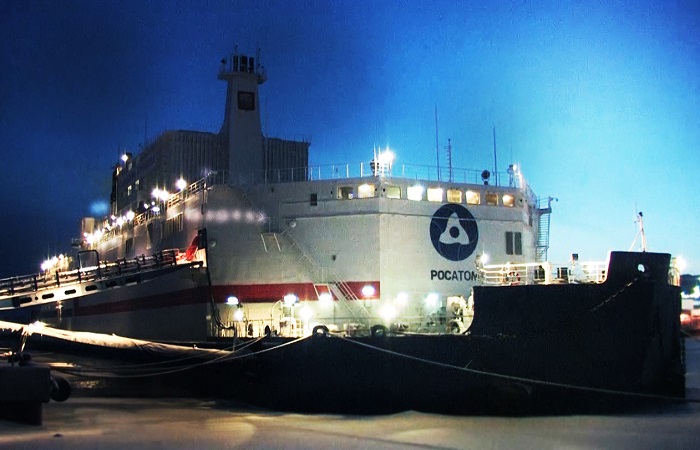
Floating nuclear power was a Russian curiosity. Now others want to give it a shot
For years, the Akademik Lomonosov looked like one of the nuclear industry’s more eccentric experiments: two reactors mounted on a barge and tow...
News
Publish date: June 30, 2005
News
“I believe, it is very important, interesting, and promising,” Putin said at a meeting with Vladimir Potanin, the chief executive of Interros, one of Russia’s largest private investment companies.
“We are continuing to work with the Russian Academy of Sciences to create national power engineering. We are positive it is the technology of the future,” said Potanin.
Potanin said they had achieved some “modest results” already and added over $100 million would have to be invested in the project.
“The main objective is to introduce the product on promising markets. Creating a product is not enough, we must be able to launch sales, above all, in developed countries,” said Potanin.
Russia’s Academy of Sciences and Norilsk Nickel, a metallurgic plant whose controlling share block is owned by Interros, signed an unprecedented agreement on cooperation in hydrogen power engineering in late 2003. Norisk Nickel was the first private company in Russia to invest up to $40 million a year in the state program on hydrogen power and fuel elements for ten years. The program is designed, above all, to establish a series of hydrogen power units, including for cars.
For years, the Akademik Lomonosov looked like one of the nuclear industry’s more eccentric experiments: two reactors mounted on a barge and tow...

Russia’s war against Ukraine continues to reshape the global nuclear industry in ways that extend beyond the battlefield. Western governments a...

Despite sweeping Western sanctions, Russia’s ambitions in the Arctic continue to advance—albeit in increasingly different ways. Novatek’s...

Even as the war grinds on, Ukraine continues to expand its civilian nuclear ambitions. Britain has tightened sanctions on Russia’s nuclear sect...