Rosatom faces pressure abroad as Zaporizhzhia’s nuclear risks deepen
August brought signs of growing pressure on several fronts for Russia’s state nuclear corporation Rosatom, from questions surrounding major construct...
News
Publish date: December 2, 2025
Written by: Charles Digges
News
Our op-ed originally appeared in The Moscow Times.
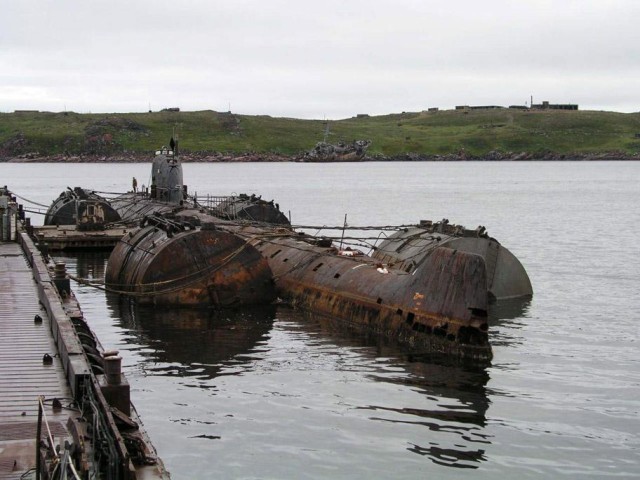
For more than three decades, Russia has been burdened with the remains of the Soviet nuclear project: a vast, sprawling, largely invisible inheritance of contaminated territories, derelict facilities, spent nuclear fuel and radioactive waste.
The nuclear legacy is a dangerous and extraordinarily expensive accumulation of hazards that still sits along the country’s Arctic coastlines, forests and former naval bases. It threatens the well-being of current and future generations and continues to impose financial and technological burdens on a government that has rarely been willing to confront its full scale.
Our latest report at Bellona shows that the system that once managed this Cold War inheritance — however imperfectly — has been hollowed out, underfunded and shrouded from public scrutiny. The result is an emerging crisis with global implications. A war-distracted Kremlin that has severed itself from decades of international cooperation is unable to meet the challenges of managing its nuclear legacy. The political and bureaucratic structures responsible for mitigating it are dying of neglect.
International experts, including Russian specialists, have long warned that nuclear legacies everywhere — whether in the United States, France, Britain or Russia — are inherently systemic, multi-layered and costly. They require decades of planning, stable financing, and transparent oversight. Russia’s own assessments, including those from Rosatom, indicate that a full remediation cycle may take more than 50 years and consume resources that stretch far beyond a single generation of managers, politicians or engineers.
And yet, two decades after launching the first Federal Target Program on nuclear and radiation safety, Russia has made only limited progress.
The core problems remain: contaminated territories that have never been rehabilitated, shabby storage of radioactive waste, tens of thousands of tons of accumulated spent nuclear fuel and derelict nuclear and radiation-hazardous facilities that were not designed to survive this long.
To understand the gravity of this, it is important to recall how Russia’s nuclear legacy was managed before the invasion of Ukraine.
Throughout the late 1990s and early 2000s, independent experts and environmental organizations — including us at Bellona — played a critical role in uncovering information that was previously inaccessible to domestic and international audiences. Our work forced the issue into the light and pushed the Russian government toward its first meaningful steps.
Even then, progress was slow and often dependent on foreign technical assistance. Until 2007, much of the cleanup in the Arctic and Far East relied on international funding from Western governments and financial institutions. Moscow’s own capacity was limited, and environmental safety ranked low on its list of priorities.
The 2007 restructuring that transformed the Federal Atomic Energy Agency into the Rosatom state corporation marked the first attempt at a centralized system. A new Directorate for Radioactive Waste and Decommissioning Policy lobbied for ambitious legislation — laws “On Radioactive Waste Management” and “On Nuclear Legacy” — intended to clarify responsibilities and create a unified national radioactive waste operator.
But critical parts of this framework were never completed. The law On Nuclear Legacy never passed. Key questions — what exactly constitutes the nuclear legacy, who owns it, who pays for it, and how success should be measured — remain unanswered even today.
Even now, more than 124 sites of “peaceful” nuclear explosions remain in legal limbo. Funding for more than 80% of cleanup obligations is not specified in any Russian regulatory act.
This system was incomplete even in peacetime. Yet it was still a system: a patchwork of laws, committees, foreign partnerships and expert oversight.
But Russia’s attack on Ukraine ended nearly all international cooperation on nuclear legacy cleanup. Western financial institutions, technical agencies, and independent experts have halted their engagement. The transparency that once existed, even if only partial, has collapsed. Today, Rosatom and federal ministries publish only fragmentary and promotional reports, devoid of the technical detail needed for genuine oversight.
This opacity is not merely a bureaucratic inconvenience. It is a warning signal. Nuclear safety depends on transparency, external verification and the constant scrutiny of engineers, regulators, researchers and the public. Without these, even well-designed systems drift toward dysfunction. Unfortunately, Russia’s system was never well designed to begin with.
The scale of the financial challenge is staggering. But the publicly available figures provide a peek. Earlier internal estimates suggested that maintaining Russia’s 20,000 tons of accumulated spent nuclear fuel in a “safe” state requires more than 24 billion rubles ($308.8 million) annually. Decommissioning and dismantling nuclear and radiation-hazardous facilities may cost around 2.5 trillion rubles ($32 billion).
But international experience shows these costs only grow. The price of Britain’s BNFL decommissioning obligations famously ballooned far beyond initial estimates. Russia is on the same trajectory, but with far weaker regulatory oversight.
Even Rosatom’s own projections reveal deeper instability: by around 2037, the corporation’s decommissioning and remediation obligations may exceed its net profit. Half of that profit is supposed to be reinvested in core business — meaning cleanup would directly compete with the sustaining of Russia’s civilian nuclear industry.
This dynamic was already dangerous before 2022. Since the war began, resources have been diverted toward military priorities, leaving nuclear legacy projects to compete for an ever-shrinking piece of the state budget. Official reports claim that roughly 75% of planned annual funding for 2024 went to environmental remediation — but none of this can be independently verified.
And it’s not just a domestic issue. It is a global headache. Many of the most hazardous phenomena — sunken nuclear submarines, reactor compartments, liquid radioactive waste reservoirs — haunt the environmentally fragile Arctic coast, a region shared by multiple states that’s critical to global climate stability.
As oversight erodes, Russia risks losing track of the condition of key facilities. Under-maintained storage infrastructure degrades. Decommissioning delays pile up. Unmonitored waste sites become potentially disastrous leaks. This is how nuclear crises emerge — not necessarily through dramatic explosions, but through slow-moving decay that becomes impossible to reverse.
The war has not only made international cooperation politically impossible. It has also made the consequences of Russian failure harder for the world to manage. With international experts sidelined, foreign governments have lost visibility into the state of facilities that, if they fail, could contaminate shared waters, migratory ecosystems or even spread transboundary radioactive pollution.
In the decades before the war, cleaning up its nuclear legacy was one of the few areas where Russia cooperated constructively with international partners. That era is over. And without that cooperation, Russia’s already strained capacity to manage its nuclear past is collapsing.
The key point is this: the nuclear legacy cannot be managed in secrecy, without stable funding, without expert participation and a functioning governmental architecture. Russia’s current political trajectory is incompatible with the long-term discipline that nuclear safety requires.
The international community must understand this not as an administrative failure but as a growing security threat — one that will outlast the war, and even the current government in the Kremlin. Nuclear legacies do not disappear. They accumulate. They demand attention, planning and accountability. Right now, Russia is incapable of doing any of this.
August brought signs of growing pressure on several fronts for Russia’s state nuclear corporation Rosatom, from questions surrounding major construct...
The International Atomic Energy Agency has suspended one of its most senior Russian officials — but for reasons largely unrelated to the questions ab...

Europe’s effort to break its dependence on Russian nuclear fuel has a paradox in Germany: making Russian-designed fuel without buying it from Russia ...
Nearly four and a half years after Russia’s full-scale invasion of Ukraine, July offered fresh evidence of how difficult it remains to disentangle Ru...