
Egypt complained about Rosatom’s nuclear work. Now it wants two more reactors
Just days after Egyptian nuclear authorities reportedly accused Rosatom of construction defects, poor management and vi...
News

Publish date: February 13, 2023
News
Today’s adoption of the delegated act defining the production of renewable hydrogen sets a long-awaited basis and clarity for projects to get off the ground. Unfortunately, the text leaves too much space for greenwashing in the short term, with a risk of increased emissions due to hydrogen production, where its purpose should, first and foremost, be to accelerate decarbonisation.
Despite these caveats, this text means policymakers finally have the clarity needed to have an informed debate on establishing hydrogen targets and the impacts of these on the European and global energy transition.
Bellona has been closely involved in the debate around this delegated act, trying to shield the power sector transition from the risk of being cannibalised by hydrogen production. Securing a strong additionality principle is crucial to ensuring hydrogen will be a catalyst for renewables deployment rather than a hold-up. Moreover, strict temporal and geographic correlation is needed to ensure hydrogen does not disrupt the overall electricity system but rather supports renewable integration by using renewable power when and where it is available.
The adopted delegated act contains all three of these elements, creating a framework for a sustainable hydrogen production system in the long term. However, long transitional periods pose a serious risk of emissions increases in the short term:
Moreover, a last-minute twist to the rules allows the use of non-renewable, low-carbon electricity without the requirement of additionality. This means that countries with a large nuclear production will potentially be able to produce hydrogen on their grids without needing to add more renewable electricity generation while calling their produced hydrogen renewable. This poses a long-term challenge as no additional capacity will come online to cover the increased need for decarbonised electricity.
Overall, Bellona welcomes the adoption of rules that clarify the issues at stake when it comes to targets and public financing of hydrogen. The creation of a solid framework for the development of a strong link between hydrogen production and additional renewable generation is also welcomed. However, the delay of the entry into force of the rules will entail an emissions increase in the short term. The last-minute inclusion of a provision to produce renewable hydrogen with non-renewable electricity is problematic due to the long-term effect this will have on the power sector emission intensity and the credibility of Europe on the international market for renewable hydrogen. With no requirement for additional renewable energy sources, any gaps in the supply for the increasing demand could be filled with gas and coal.
Marta Lovisolo, Policy Advisor on Renewable Energy Systems, said, “ensuring renewable hydrogen is produced from additional renewable electricity sources has been a key subject these past years. Although this won’t come fast enough to our taste, and nuclear electricity will be able to be accounted as renewable, we are relieved that additionality is a key part of the delegated act nonetheless”.
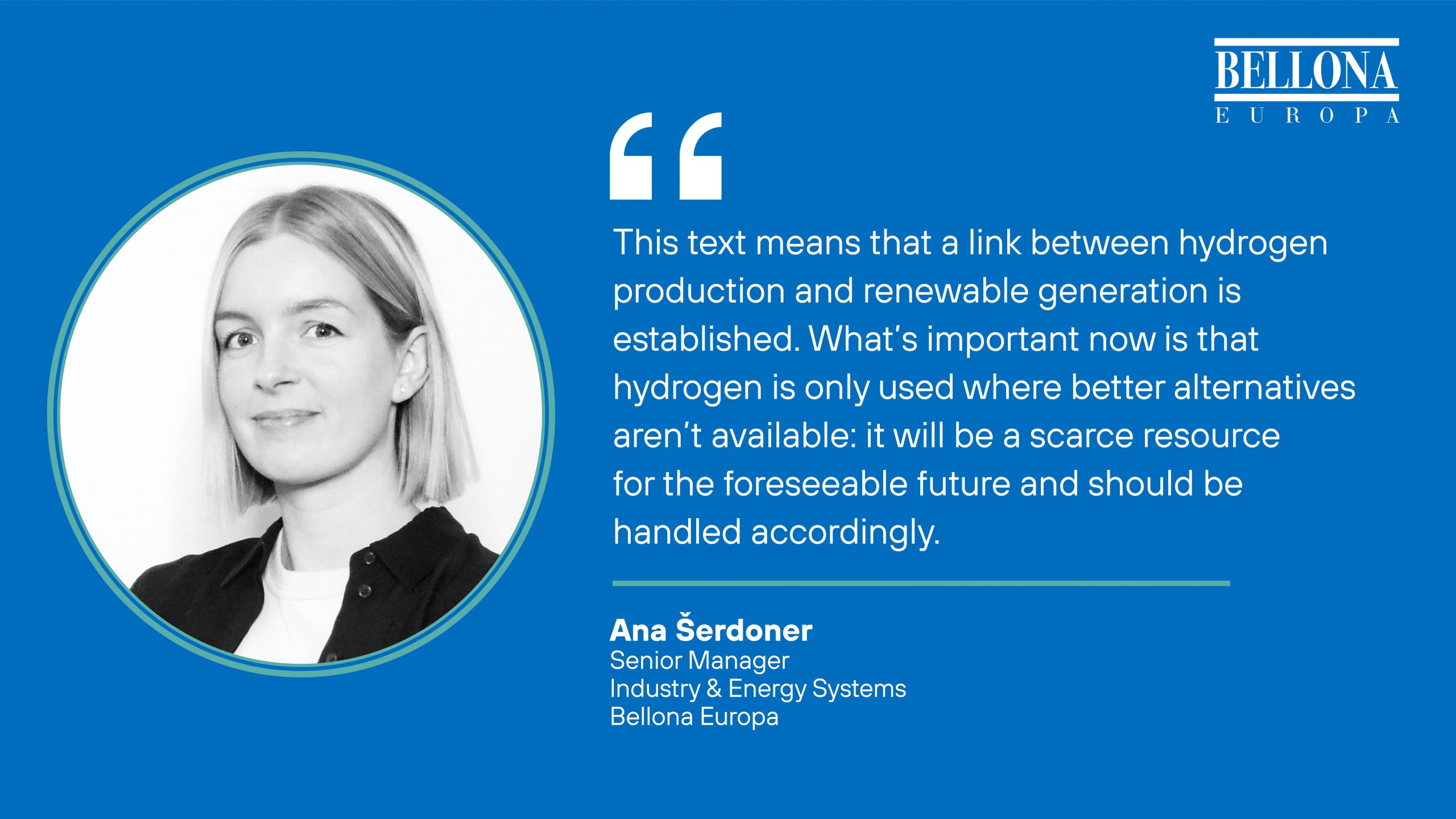
Ana Šerdoner, Senior Manager Industry & Energy Systems at Bellona Europa, said, “this text means that a link between hydrogen production and renewable generation is established. What’s important now is that hydrogen is only used where better alternatives aren’t available: it will be a scarce resource for the foreseeable future and should be handled accordingly.”

Just days after Egyptian nuclear authorities reportedly accused Rosatom of construction defects, poor management and vi...

For years, the Akademik Lomonosov looked like one of the nuclear industry’s more eccentric experiments: two reactors mounted on a barge and tow...
Russia’s war against Ukraine continues to reshape the global nuclear industry in ways that extend beyond the battlefield. Western governments a...

Despite sweeping Western sanctions, Russia’s ambitions in the Arctic continue to advance—albeit in increasingly different ways. Novatek’s...