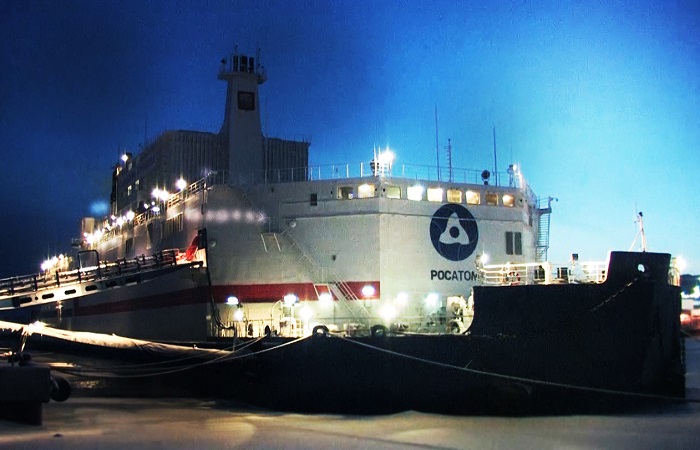
Floating nuclear power was a Russian curiosity. Now others want to give it a shot
For years, the Akademik Lomonosov looked like one of the nuclear industry’s more eccentric experiments: two reactors mounted on a barge and tow...
News
Publish date: June 3, 1999
Written by: Igor Kudrik
News
Cogema Technologies, Inc., a U.S. subsidiary of Cogema Inc., was awarded a contract by Lockheed Martin Energy Technology to design and supply two solid waste treatment and conditioning systems for the Zvezdochka and Zvezda shipyards in northern and eastern Russia. Both shipyards are heavily involved in decommissioning of nuclear-powered submarines.
The project is a part of the Co-operative Threat Reduction program. The program was commissioned in 1991 by the U.S. Congress to help secure former Soviet weapons of mass destruction. One of the program’s objectives is to aid Russia to dismantle ballistic missile submarines and secure spent fuel and waste, deriving from the decommissioning operations.
Zvezdochka shipyard, Archangel County, had a solid waste incineration facility built in early 80-s. The facility was capable of processing non-metal waste (plastics, rags), but has never been in full operation. In late 80-s it was practically taken out of service.
The new facility will include a solid waste sorting glove box, a scrap metal decontamination system, size reduction equipment, and a compactor for non-metal waste.
For years, the Akademik Lomonosov looked like one of the nuclear industry’s more eccentric experiments: two reactors mounted on a barge and tow...
Russia’s war against Ukraine continues to reshape the global nuclear industry in ways that extend beyond the battlefield. Western governments a...

Despite sweeping Western sanctions, Russia’s ambitions in the Arctic continue to advance—albeit in increasingly different ways. Novatek’s...
Even as the war grinds on, Ukraine continues to expand its civilian nuclear ambitions. Britain has tightened sanctions on Russia’s nuclear sect...