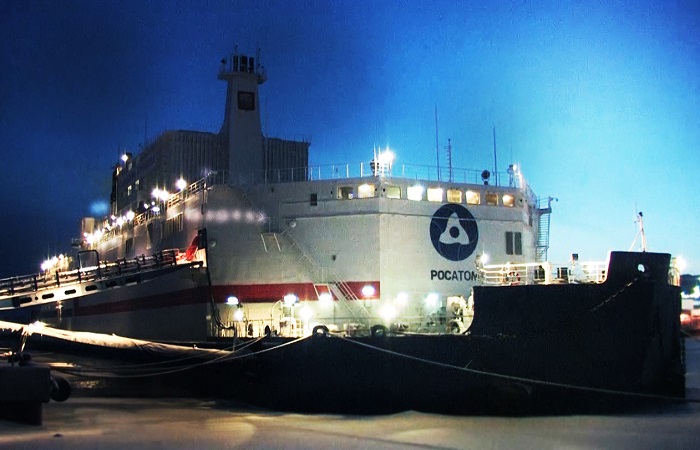
Floating nuclear power was a Russian curiosity. Now others want to give it a shot
For years, the Akademik Lomonosov looked like one of the nuclear industry’s more eccentric experiments: two reactors mounted on a barge and tow...
News

Publish date: December 7, 2001
Written by: Runar Forseth
News
Fully equipped with climbers’ security gear, two activists climbed the tall Christmas tree at Trafalgar Square this morning, hanging out banners with the message "Stop Sellafield". The two intend to remain in the tree for as long as possible.
A member of the ground team, Bellona President Frederic Hauge stated, "every year at Christmas time Norway gives a tall tree to the English people. In return Norway receives huge amounts of radioactivity from the Sellafield nuclear plant in England, contaminating our Arctic seas."
Scientist have measured an alarming increase in levels of radioactive techetium-99 in sea weed and shell-fish since 1994, when Sellafield dramatically increased its discharges of the compound to the Irish Sea. Technetium-99 has a half-life of 211,000 years, and hence accumulates in the nutritional chain. Now, the British are planing to increase the discharges even further.
"To save some lousy pounds, the British have chosen to keep up a pollution discharge that nobody knows the consequences of. What we do know for certain, is that we’ll have to live with those consequences for posterity", Hauge said.
Coincidentally, Camvista.com has put up several webcams at Trafalgar Square. If you’re lucky, you’ll see some of the activists.
More pictures
 Photo: Nils Bøhmer/Bellona
For years, the Akademik Lomonosov looked like one of the nuclear industry’s more eccentric experiments: two reactors mounted on a barge and tow...
Russia’s war against Ukraine continues to reshape the global nuclear industry in ways that extend beyond the battlefield. Western governments a...
Despite sweeping Western sanctions, Russia’s ambitions in the Arctic continue to advance—albeit in increasingly different ways. Novatek’s...
Even as the war grinds on, Ukraine continues to expand its civilian nuclear ambitions. Britain has tightened sanctions on Russia’s nuclear sect...