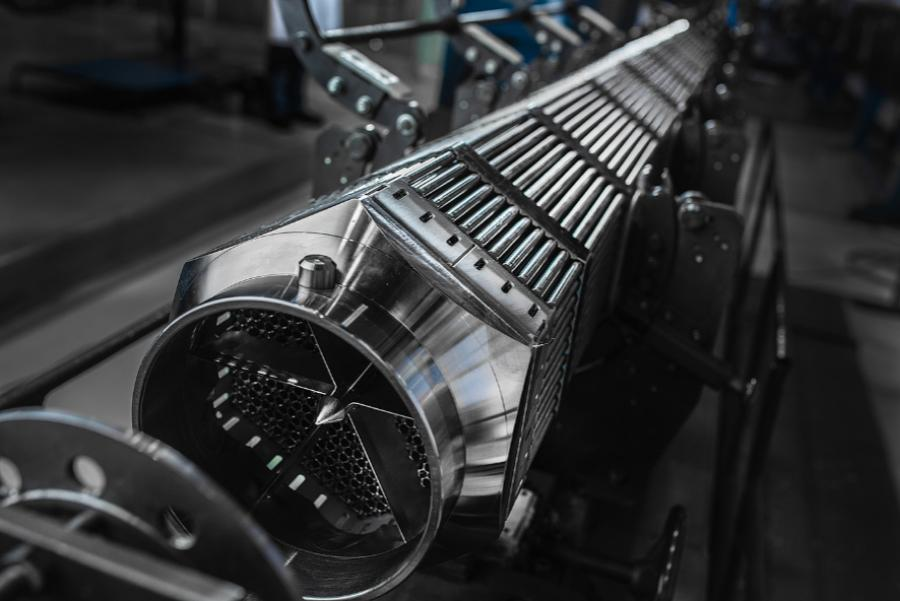
Germany wants independence from Russian nuclear fuel, using Rosatom as a bridge
Europe’s effort to break its dependence on Russian nuclear fuel has a paradox in Germany: making Russian-designed fuel without buying it from Russia ...
News
Publish date: June 13, 1997
Written by: Igor Kudrik
News
In the beginning of 1997, SKB (Sweden), Kvaerner Maritime (Norway), BNFL (UK) and SGN (France) joined each other in an industrial group, with the purpose to propose cost-effective solutions for spent nuclear fuel management in North-west Russia and to deal with funding institutions.
French SGN is expert on various fuel retrieval and storage technologies, having experience from projects in North-west Russia in co-operation with the Russian Ministry of Atomic Energy (Minatom) and its research institutions. Kvaerner Maritime is managing projects concerning vital links in the fuel cycle (such as provision of ships and railway wagons for spent fuel transport) and evaluation of the situation in this area, under a Norwegian-Russian agreement. SKB is acting as responsible for all activities related to the nuclear back end in Sweden. BNFL has experience in Russia from projects in co-operation with the Mayak reprocessing plant.
The first part of the project will follow the closed fuel cycle principle established in Russia, presuming shipment of spent nuclear fuel to Mayak plant for interim storage and further reprocessing. Since the existing on-site storage facilities at Mayak are overfilled and inadequate for long-term storage, the main intention of the industrial group is to provide Mayak with a long term storage facility for spent nuclear fuel. Currently at Mayak, there is a partly built wet storage facility available, that is to be upgraded in order to comply with modern design safety standards. However, the industrial group will evaluate several alternative solutions (new dry storage facility, new wet storage facility, or upgrading of the existing partly built wet storage facility) in order to make the right decision.
The second part of the project is to look into possible ways of treating the spent fuel that can not be reprocessed at Mayak, in particular damaged fuel, fuel from liquid metal cooled reactors and fuel in circonium cladding.
For the time being, the Russian counterpart is the St. Petersburg Scientific Research Institute of Industrial Technology (VNIPIET), a Minatom subject. The institute has 50 years’ experience in spent nuclear fuel and radioactive waste management. Among other things, VNIPIET was the chief designer of the storage facilities of the Northern Fleet, located in Andreeva guba and Gremikha on the Kola Peninsula. Both storage facilities suffered accidents in the course of the 80’s and are currently taken out of operation. VNIPIET is also a chief designer of the Belyanka class (pr. no 11510) transport vessels. Two vessels of this class have been built, to transport and process liquid radioactive waste. For the time being, the processing facilities on both of the vessels are out of service.
According to representative of SGN C. Bonnet, the project is in progress. Specific agreements have already been signed with VNIPIET, while the Mayak subproject has been submitted to the funding bodies.
Europe’s effort to break its dependence on Russian nuclear fuel has a paradox in Germany: making Russian-designed fuel without buying it from Russia ...
Nearly four and a half years after Russia’s full-scale invasion of Ukraine, July offered fresh evidence of how difficult it remains to disentangle Ru...

Just days after Egyptian nuclear authorities reportedly accused Rosatom of construction defects, poor management and vi...
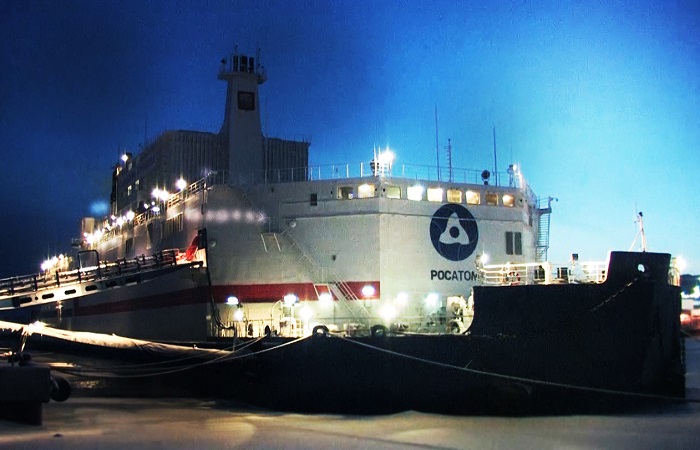
For years, the Akademik Lomonosov looked like one of the nuclear industry’s more eccentric experiments: two reactors mounted on a barge and tow...