
From reactors to shipping: Rosatom tightens its grip on Russian transport
Russia’s state nuclear corporation Rosatom has taken full control of one of the country’s largest logistics companies, consolidating an expanding tra...
News
Publish date: October 1, 2026
Written by: Charles Digges
News
The International Atomic Energy Agency has suspended one of its most senior Russian officials — but for reasons largely unrelated to the questions about Russian influence at the agency that have surrounded him since Moscow seized Ukraine’s Zaporizhzhia nuclear power plant.
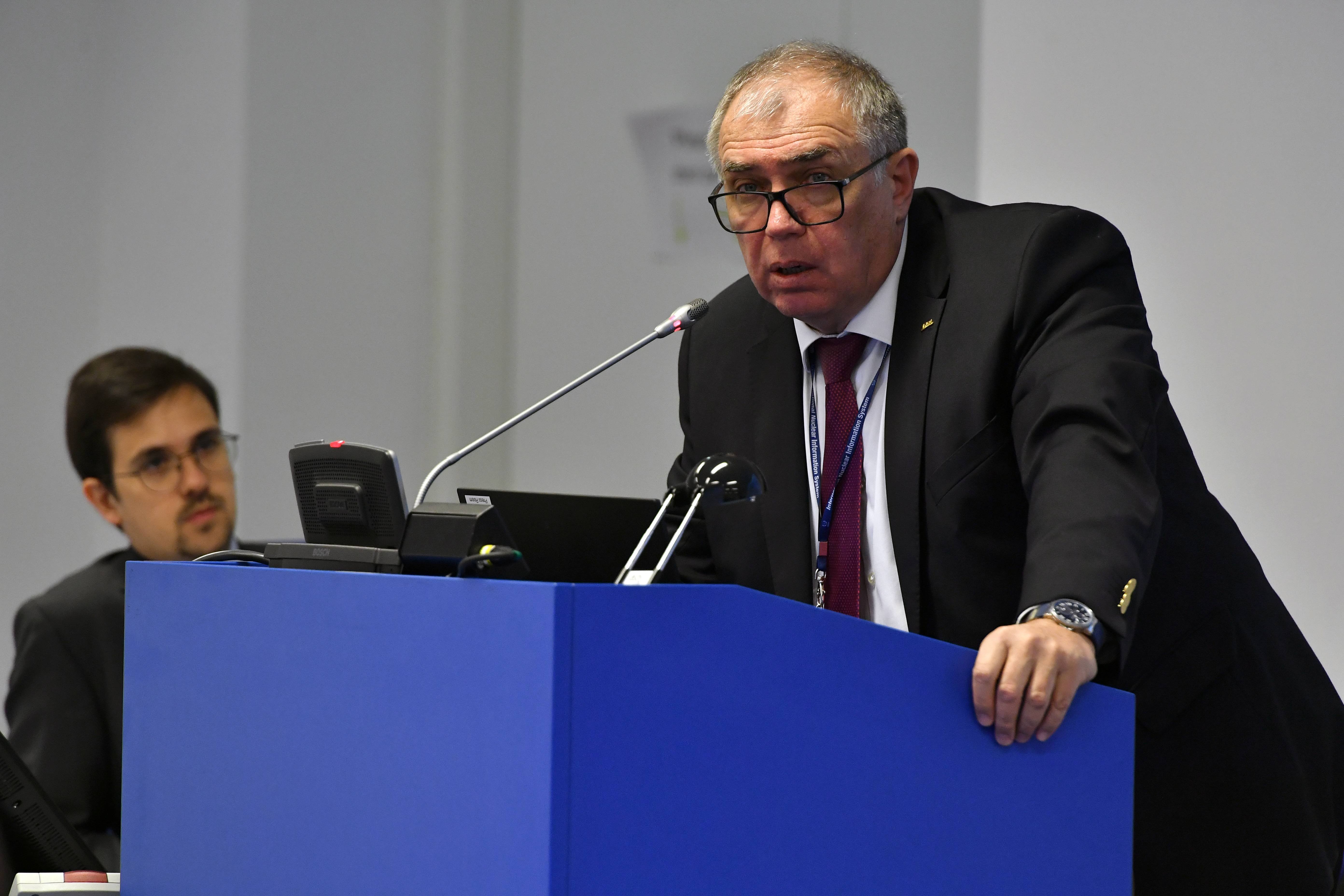
Mikhail Chudakov, an IAEA deputy director general and head of its Department of Nuclear Energy since 2015, was placed on administrative leave this month pending an internal ethics investigation, according to Bloomberg.
The investigation concerns a 76-page book, Treatise on Life, which Chudakov published under the pseudonym Valentin Voyutin in 2025. The book contains disparaging descriptions of feminists and LGBT people and expresses support for authoritarian government.
According to Bloomberg, the book came to the IAEA’s attention after Chudakov promoted it among members of Vienna’s young nuclear community. Members of the group subsequently brought it to the agency’s ethics office. The IAEA, Chudakov and Director General Rafael Grossi have not publicly commented on the case.
But Chudakov’s suspension has reopened a different question that predates the book by years: whether a former senior official of Russia’s state nuclear industry should have remained in one of the IAEA’s most influential positions after Russia invaded Ukraine and Rosatom became directly involved in the occupation of the Zaporizhzhia nuclear plant.
Greenpeace International raised precisely that issue in March 2022, less than two weeks after Russian forces seized Zaporizhzhia. In a letter, the organization called on Grossi to suspend Chudakov, citing his decades-long career in Russia’s nuclear establishment and requesting disclosure of any communications between him and Rosatom officials following the invasion.
Greenpeace argued that Chudakov’s presence could undermine Ukrainian confidence in the confidentiality of information shared with the IAEA during the nuclear crisis. No public evidence has emerged showing that Chudakov provided confidential information to Rosatom. Chudakov nevertheless remained in his position for another four years.
The significance of that position extends well beyond the IAEA’s response to Zaporizhzhia. The Department of Nuclear Energy works with countries planning new nuclear programs and oversees areas including reactor technology, small modular reactors, the nuclear fuel cycle, nuclear infrastructure and training.
Chudakov has also headed the IAEA’s International Project on Innovative Nuclear Reactors and Fuel Cycles, or INPRO, and chaired the steering committee of its Platform on Small Modular Reactors and their Applications.
At the same time, cooperation between the IAEA and Russian nuclear institutions continued after the invasion.
In October 2024, the agency renewed and expanded the status of Rosatom’s Technical Academy as an IAEA Collaborating Center. Joint programs have continued to bring nuclear specialists from other countries to Russian facilities.
In September 2025, Chudakov personally led an IAEA delegation to Rosatom’s Akademik Lomonosov floating nuclear power plant in Chukotka. The visit was hosted by Rosenergoatom, where Chudakov previously held senior positions, at a time when Rosatom was increasingly promoting floating and land-based small reactors to potential foreign customers.
For Bellona nuclear expert Alexander Nikitin, such relationships point to a broader problem confronting the IAEA since Russia’s invasion. The war, he says, has divided nuclear countries into aggressors, victims of aggression and relatively neutral states, while the international nuclear industry continues to operate largely under rules created before the Russian invasion of Ukraine.
“The international nuclear sector continues to function without a referee and under the international regulatory framework that existed before the war,” Nikitin said.
That makes the individuals making decisions within the IAEA particularly important, he argues, including decisions about supporting nuclear projects in countries seeking to develop nuclear power.
But determining when ordinary IAEA cooperation crosses the line into advancing Rosatom’s interests is considerably more difficult.
According to Bellona nuclear expert Dmitry Gorchakov, Ukraine’s desire to remove Chudakov following the invasion was understandable, but attempting to do so simply because of his Rosatom background and continuing contacts with the Russian nuclear industry had little prospect of succeeding under IAEA rules.
“It is extremely difficult to prove that he is working specifically in Rosatom’s interests rather than those of the IAEA — which could indeed provide grounds for his removal,” Gorchakov said.
The problem, he says, is the unusually close overlap between their interests. The IAEA promotes the development of nuclear energy internationally. Rosatom also develops nuclear energy internationally, albeit for its own commercial and political purposes.
None of Chudakov’s contacts with Russian nuclear organizations therefore necessarily demonstrates improper conduct. Other major nuclear countries also host IAEA training and technical programs, while the agency necessarily works with the nuclear industries of its member states.
And although the IAEA Board of Governors and General Conference have repeatedly adopted resolutions condemning Russian actions in Ukraine, Gorchakov notes that they have never instructed the IAEA Secretariat — Grossi and the staff working beneath him — to cease cooperation with Russia or Rosatom.
“Many of Chudakov’s contacts and actions in his position at the IAEA can have perfectly understandable explanations arising from his official responsibilities and, at least formally, do not contradict them,” Gorchakov said.
Even Ukraine’s membership on the IAEA Board of Governors from 2023 to 2025 failed to change that situation.
Yet days after Chudakov’s suspension, Ukrainian military intelligence added a new allegation. It claimed on September 16 that Chudakov helped secure the depiction of Russian-occupied Crimea as Russian territory in the IAEA’s Power Reactor Information System, or PRIS, and that Russian representatives were seeking the use of Russified names including “Rovno,” “Khmelnitski” and “Zaporozhye” for Ukrainian nuclear locations.
Those allegations have not been independently confirmed by the IAEA.
For Gorchakov, the irony is that after years of controversy over Chudakov’s Russian connections, none of those issues ultimately caused his suspension. Instead, Chudakov appears to have created the grounds himself.
“It was only when Chudakov himself created a problem through his book — which apparently contains numerous clear conflicts with the Agency’s ethical standards — that it became possible to accomplish, at least partially, what had previously proved impossible to achieve or demonstrate through other means,” Gorchakov said.
His suspension may remove one controversial official. But the larger question — how an international nuclear organization should work with the nuclear industry of a member state waging war and occupying another country’s nuclear power plant — remains unresolved.
Russia’s state nuclear corporation Rosatom has taken full control of one of the country’s largest logistics companies, consolidating an expanding tra...
August brought signs of growing pressure on several fronts for Russia’s state nuclear corporation Rosatom, from questions surrounding major construct...

Europe’s effort to break its dependence on Russian nuclear fuel has a paradox in Germany: making Russian-designed fuel without buying it from Russia ...
Nearly four and a half years after Russia’s full-scale invasion of Ukraine, July offered fresh evidence of how difficult it remains to disentangle Ru...