Rosatom advances nuclear projects abroad as sanctions gaps and wartime ties draw scrutiny
Russia’s state nuclear corporation Rosatom made progress on two of its international reactor projects in recent weeks, bringing new generating ...
News
Publish date: August 20, 2026
Written by: Charles Digges
News
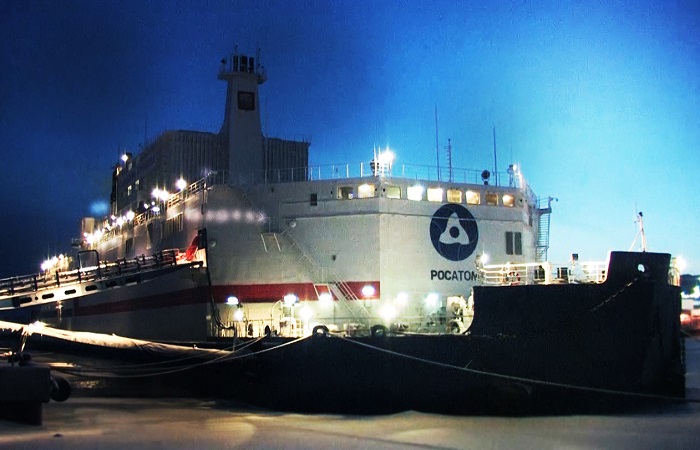
For years, the Akademik Lomonosov looked like one of the nuclear industry’s more eccentric experiments: two reactors mounted on a barge and towed thousands of kilometers to Pevek, a tiny Russian port above the Arctic Circle.
But next week, representatives of the nuclear and maritime industries will gather in Washington to discuss whether something resembling Russia’s experiment could become considerably more commonplace.
On August 26 and 27, the International Atomic Energy Agency will formally launch ATLAS — Atomic Technologies Licensed for Applications at Sea — an initiative aimed at developing an international bureaucratic framework for civilian nuclear technologies at sea. The project encompasses both floating nuclear power plants and nuclear-powered commercial ships, bringing together two industries whose regulatory worlds have historically not much intersected.
The event is significantly timed. After decades on the fringes of the nuclear industry, maritime reactors are attracting new interest as small modular reactor developers search for markets and the shipping industry looks for ways to decarbonize.
The United States is already preparing. In July, the Nuclear Regulatory Commission and the Marine Minerals Administration signed an agreement establishing how the agencies would divide responsibility if developers propose nuclear projects on the U.S. Outer Continental Shelf. No such commercial projects have yet been proposed, but the government is creating a regulatory pathway before they arrive. The NRC is separately developing guidance for licensing floating plants and nuclear propulsion systems.
None of this is entirely theoretical. Russia’s Akademik Lomonosov has been supplying electricity from Pevek since 2019 and entered commercial operation in 2020. Its two KLT-40S reactors provide roughly 70 megawatts of generating capacity, making it the world’s only operating commercial floating nuclear power station.
Bellona has followed—and criticized—the project since construction began in 2006, raising questions about its economics, radioactive waste, spent fuel, maritime accidents and the risks inherent in moving nuclear materials through remote Arctic waters. The plant also became an illustration of nuclear megaproject delays: construction ultimately took 13 years rather than the four originally envisioned.
But Rosatom has not abandoned the concept. Quite the opposite.
The Russian state nuclear corporation is now trying to turn the Lomonosov experiment into a repeatable model. Four newer floating power units equipped with RITM-200S reactors are planned to supply the remote Baimskaya mining project in Chukotka. In May, Rosatom announced completion of the first reactor unit for the project.
That project also demonstrates why floating nuclear power may prove considerably more complicated than simply putting a small reactor on a barge.
Russian shipyards lacked the capacity to build the first two hulls on the required schedule, forcing Rosatom to outsource them to China’s Wison shipyard. The first Chinese-built hull arrived at the Baltic Shipyard in St. Petersburg this spring, where its Russian reactors and turbines are to be installed.
In other words, floating nuclear plants promise factory-style construction, but Russia’s experience suggests that they still require an elaborate international industrial supply chain.
The renewed enthusiasm for nuclear power at sea also arrives at an unsettling moment for international nuclear security. Recent wars have challenged a longstanding assumption underlying civilian nuclear power—that reactors and other nuclear facilities remain insulated from military conflict.
Russia’s occupation of Ukraine’s Zaporizhzhia Nuclear Power Plant has turned Europe’s largest nuclear station into part of an active war zone, repeatedly exposing the site to explosions, drone activity and losses of external power. In February 2025, a drone struck and badly damaged the New Safe Confinement protecting the remains of the destroyed Chernobyl reactor. And this year, projectiles struck the grounds of Iran’s operating Bushehr Nuclear Power Plant during the war there, though no reactor damage or radioactive release was reported.
None of these incidents produced a major radiological accident. But together they raise a question that becomes especially important as nuclear power moves offshore: Does mobility make a reactor safer in wartime—or simply create new ways for it to become vulnerable?
A floating plant could theoretically be moved away from a threatened area, something impossible for a conventional reactor. But a reactor moored in a harbor or supplying an isolated military, mining or industrial installation could also become a conspicuous strategic target. Its electrical connections, cooling systems, moorings and supporting infrastructure may be more exposed than those of a heavily protected land-based plant. And a nuclear-powered commercial ship introduces another problem entirely: unlike Zaporizhzhia or Bushehr, it could actually sail into or through a conflict zone.
The technical problems with floating nuclear plants may be easier to solve than the legal ones. Nuclear regulation has traditionally assumed that a reactor stays put. Maritime law, by contrast, is built around vessels that cross borders and operate under different flag, coastal and port-state jurisdictions. A floating reactor forces those systems together.
Who licenses a reactor built in one country, registered in another and moored in a third? Who takes responsibility for its nuclear waste and spent fuel? Which country is responsible for safeguards if the plant moves? What happens when a nuclear-powered ship enters a foreign port—or when a floating reactor must be evacuated because of war or extreme weather?
The IAEA has identified refueling, maintenance, remote operation, safeguards, security and international regulatory harmonization among the issues that must be resolved. Meanwhile, the International Maritime Organization is revising its own 1981 safety code for nuclear merchant ships, with adoption of a new code currently envisioned for 2030.
The appeal nevertheless seems obvious. Floating plants could be assembled in specialized shipyards rather than constructed individually at remote sites, then delivered to isolated communities, mines, islands or industrial projects whose grids cannot support conventional gigawatt-scale reactors. When their work is finished, they could theoretically be removed.
That is the vision ATLAS will begin trying to turn into a workable international system next week.
Russia, meanwhile, has already spent nearly two decades discovering what happens when that idea encounters reality. Its experience suggests floating nuclear power can work—to a point. Whether it can be made economical, replicable and safe enough to operate around the world is a much larger question—and one the rest of the nuclear industry is suddenly eager to answer.
Russia’s state nuclear corporation Rosatom made progress on two of its international reactor projects in recent weeks, bringing new generating ...
Armenia is reconsidering its plans for a new nuclear power plant after a fresh proposal from Russia’s state nuclear corporation Rosatom and a s...

Russia’s state nuclear corporation Rosatom has taken full control of one of the country’s largest logistics companies, consolidating an expanding tra...
August brought signs of growing pressure on several fronts for Russia’s state nuclear corporation Rosatom, from questions surrounding major construct...