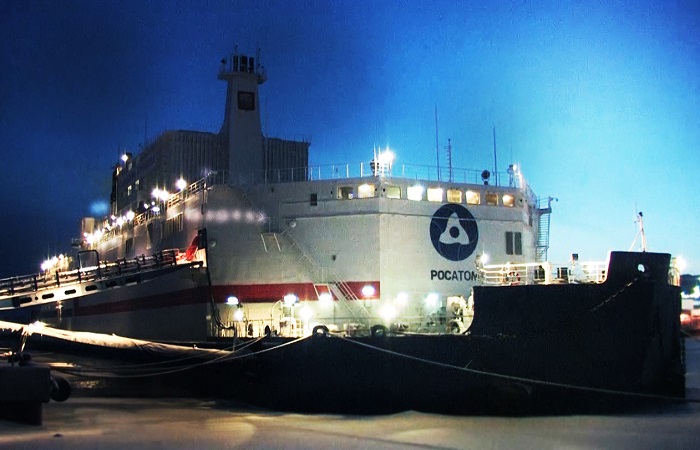
Floating nuclear power was a Russian curiosity. Now others want to give it a shot
For years, the Akademik Lomonosov looked like one of the nuclear industry’s more eccentric experiments: two reactors mounted on a barge and tow...
News

Publish date: May 21, 2021
News
As Russia begins its two-year chairmanship of the Arctic Council, Bellona supports an international response to raising nuclear submarines and other radioactive debris scuttled by the Soviet Union in Arctic seas.
In a letter to council members sent this week, Bellona wrote that it “sincerely believes that the period of the Russian Federation’s chairmanship of the Arctic Council can and should become a new stage in fruitful cooperation between the Arctic countries to bring the Arctic seas to a safe condition.”
The organization wrote further that recovering and disposing of radioactive waste and nuclear submarines dumped in the waters surrounding the North Pole would be “not only to Russia’s benefit, but the benefit of all participating countries” that make up the seven-nation council.
To accomplish this, Bellona urges the council to adopt what it calls the “Safe Arctic Waters,” project, which would facilitate engineering surveys of the seabed where the waste lies, as well as galvanize international funding and expertise around its retrieval.
For years, the Akademik Lomonosov looked like one of the nuclear industry’s more eccentric experiments: two reactors mounted on a barge and tow...

Russia’s war against Ukraine continues to reshape the global nuclear industry in ways that extend beyond the battlefield. Western governments a...

Despite sweeping Western sanctions, Russia’s ambitions in the Arctic continue to advance—albeit in increasingly different ways. Novatek’s...

Even as the war grinds on, Ukraine continues to expand its civilian nuclear ambitions. Britain has tightened sanctions on Russia’s nuclear sect...