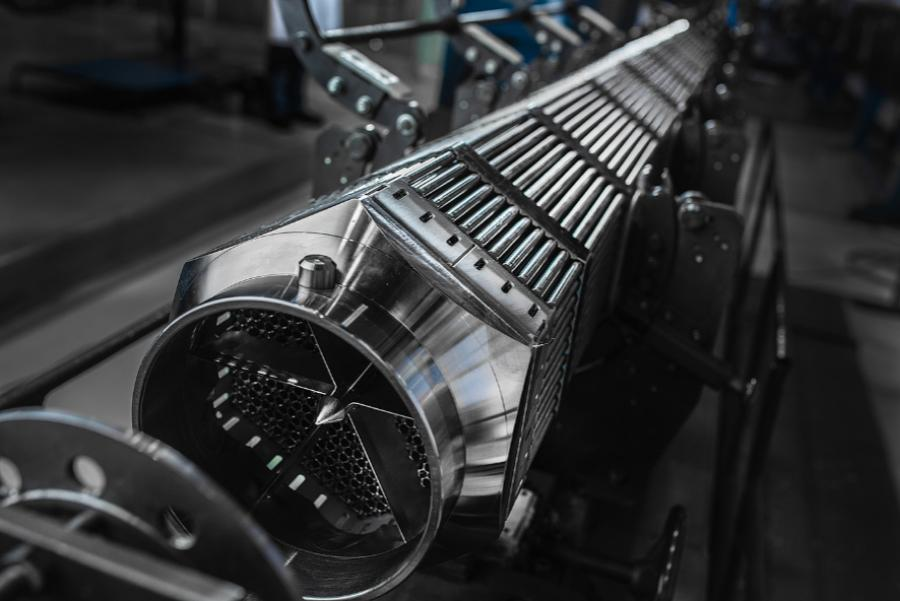
Germany wants independence from Russian nuclear fuel, using Rosatom as a bridge
Europe’s effort to break its dependence on Russian nuclear fuel has a paradox in Germany: making Russian-designed fuel without buying it from Russia ...
News
Publish date: January 12, 2007
News
A gas sensor was activated on board one of the submarines belonging to the Russian Pacific Fleet, Dygalo told Interfax-AVN.
"A preliminary check has revealed a malfunction of this sensor. The missile was removed from its silo and brought to an onshore storage facility to establish the cause of the failure," Russian Navy spokesman Captain Igor Dygalo said. "The missile is in a good condition. There was no oxidant leakage," he added.
Media reports claiming a leakage of rocket fuel components aboard a nuclear submarine are "totally untrue," Dygalo said. Far East group of troops spokesman Georgy Romanovich also said that "there was no emergency aboard this submarine." A faulty sensor was activated, he said, adding that it is being replaced now. The situation does not pose any threat to the population, he said.
The local authorities, however, told the inhabitants to stay home and dismissed children from schools and kindergartens.
The Russian strategic submarines of Delta-III class of the Pacific Fleet are included into the 16th Squadron, based in Rybachiy (Krasheninnikov Bay, Kamchatka Peninsula). The squadron includes four project 667BDR submarines – K-211 Petropavlovsk-Kamchatskiy, K-223 Podolsk, K-433 Sv. Georgiy Pobedonosets, and K-506 Zelenograd. Each submarine is capable to carry 16 of the R-29R (RSM-50), or SS-N-18 «Stingray», missiles with a range of 6,500 to 8,000 km. The liquid missile fuel consists of unsymmetrical dimethylhydrazine, and nitrogen tetroxide as oxidant. Both components are poisonous, and the oxidant is also extremely aggressive.
Europe’s effort to break its dependence on Russian nuclear fuel has a paradox in Germany: making Russian-designed fuel without buying it from Russia ...

Nearly four and a half years after Russia’s full-scale invasion of Ukraine, July offered fresh evidence of how difficult it remains to disentangle Ru...

Just days after Egyptian nuclear authorities reportedly accused Rosatom of construction defects, poor management and vi...
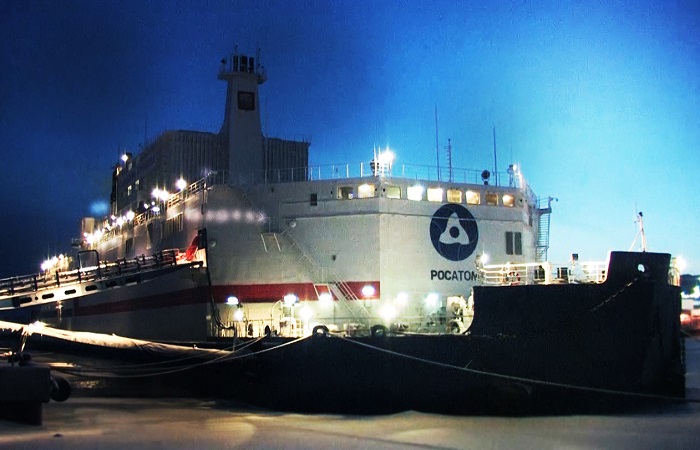
For years, the Akademik Lomonosov looked like one of the nuclear industry’s more eccentric experiments: two reactors mounted on a barge and tow...