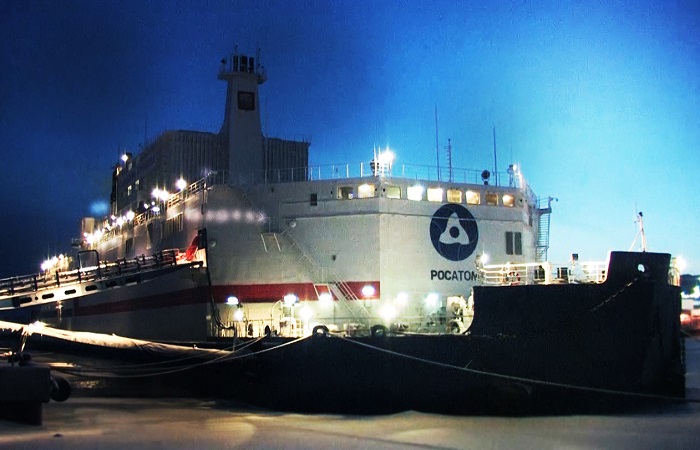
Floating nuclear power was a Russian curiosity. Now others want to give it a shot
For years, the Akademik Lomonosov looked like one of the nuclear industry’s more eccentric experiments: two reactors mounted on a barge and tow...
News
Publish date: February 7, 2003
News
The defuelling of nuclear submarines is primarily carried out by the Northern Fleets two nuclear support vessels of the Project 2020 — Malina class, and by four Project 326M vessels (See subchapter 1.4.3 Service ships for spent nuclear fuel). The Project 326M vessels require overhaul repairs, which is regularly conducted every 10 years. The procedure can take up to two years and costs around $6 million for each vessel. Minatom funded maintenance of the Project 326M ships, with the last repairs on the three vessels having been performed in 2000. The vessels have no licence to sail between the various bases due to safety concerns and will consequently become stationary. The spent fuel from these vessels will be collected by Murmansk Shipping Company nuclear support vessels Imandra and Lotta, which will further deliver the spent fuel to Atomflot base in Murmansk where it will be reloaded onto a special train. The spent fuel is then transported by rail to the Mayak reprocessing plant.
In 1998-1999, PM-63, a Malina class nuclear support vessel , stationed in Severodvinsk, was repaired with the use of CTR funds. The fuel unloaded from the submarine reactors in Severodvinsk was transported by rail to the Mayak plant from a fuel transfer point located there.
Murmansk Shipping Companys nuclear support vessel Imandra was also used in both 1999 and 2000 to defuel three Victor-II class submarines at Nerpa shipyard and at Shkval shipyard in Polyarny. The vessel continues to perform defuelling operations at various shipyards and naval bases.
The Northern Fleets nuclear support fleet has the capacity to defuel a maximum of eight submarines per year. The Imandra can defuel a maximum of three to four submarines per year.
The Northern Fleet possesses eight sets of equipment which are specially used in the defuelling of first and second generation submarines, all of which require repair. The cost of repairing one set is around $400,000. To manufacture a brand new set will cost one million USD. Repair work on these sets reportedly began in 1999.
For years, the Akademik Lomonosov looked like one of the nuclear industry’s more eccentric experiments: two reactors mounted on a barge and tow...
Russia’s war against Ukraine continues to reshape the global nuclear industry in ways that extend beyond the battlefield. Western governments a...

Despite sweeping Western sanctions, Russia’s ambitions in the Arctic continue to advance—albeit in increasingly different ways. Novatek’s...
Even as the war grinds on, Ukraine continues to expand its civilian nuclear ambitions. Britain has tightened sanctions on Russia’s nuclear sect...