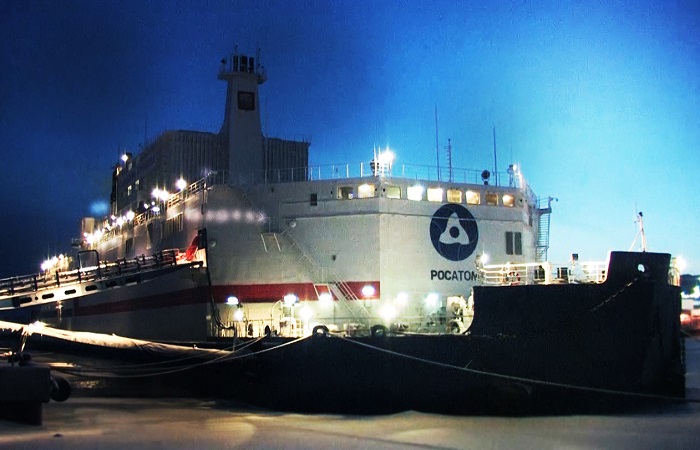
Floating nuclear power was a Russian curiosity. Now others want to give it a shot
For years, the Akademik Lomonosov looked like one of the nuclear industry’s more eccentric experiments: two reactors mounted on a barge and tow...
News
Publish date: February 6, 2003
News
TUK-11 and TUK-12 containers were used for all reloading of fuel from nuclear vessels until 1993, and in 1994 they were replaced by the TUK-18 container. The TUK-11 and TUK-12 containers were manufactured in 1971-72 by the Uralmash factory in Ekaterinburg. The main difference between the two types of containers is in the height. Each container held one holster in which seven fuel assemblies had been packed. (The cylinders for Murmansk Shipping Company held three to five fuel assemblies). The containers were made of stainless steel, weighed 8,850 kg each and were 327 mm thick. The closed cylinders were also made of stainless steel, and weighed 260 to 300 kg when fully equipped. The TUK-11 and TUK-12 containers were transported on TK-4 railroad cars, each of which could hold four containers. In this way, a special train of nine or ten cars could transport one reactor core; a special train of 18-20 cars could take a maximum of two reactor cores. Before the TUK-11 and TUK-12 type containers were introduced, the earlier model TUK-6 containers were in use.
By 1993, the TUK-11 and TUK-12 containers had become obsolete, and from 1994 onwards, TK-18 (TUK-18) containers have been used exclusively for the transport of spent naval fuel. The TK-18 containers were manufactured by the Izhorsky factory in the city of Kolpino. These too are made of stainless steel, and a single container weighs 40 tons with a thickness of 320 mm. Each TK-18 container holds up to seven closed cylinders, and each cylinder can take five to seven fuel assemblies. In 1989, four special railroad cars of the type TK-VG-18 were built at the Kalininsky Coach Works to transport the TK-18 containers. A TK-VG-18 car can accommodate three TK-18 containers. The Russian Navy has 50 of these containers, half of which are owned by the Northern Fleet. A special train pulling four TK-VG-18 cars with their full capacity of twelve TK-18 containers is capable of transporting two to three reactor cores. The construction of a second set of four TK-VG-18 cars was funded by Norway. Those cars were taken into operation in autumn 2000.
For years, the Akademik Lomonosov looked like one of the nuclear industry’s more eccentric experiments: two reactors mounted on a barge and tow...
Russia’s war against Ukraine continues to reshape the global nuclear industry in ways that extend beyond the battlefield. Western governments a...

Despite sweeping Western sanctions, Russia’s ambitions in the Arctic continue to advance—albeit in increasingly different ways. Novatek’s...
Even as the war grinds on, Ukraine continues to expand its civilian nuclear ambitions. Britain has tightened sanctions on Russia’s nuclear sect...