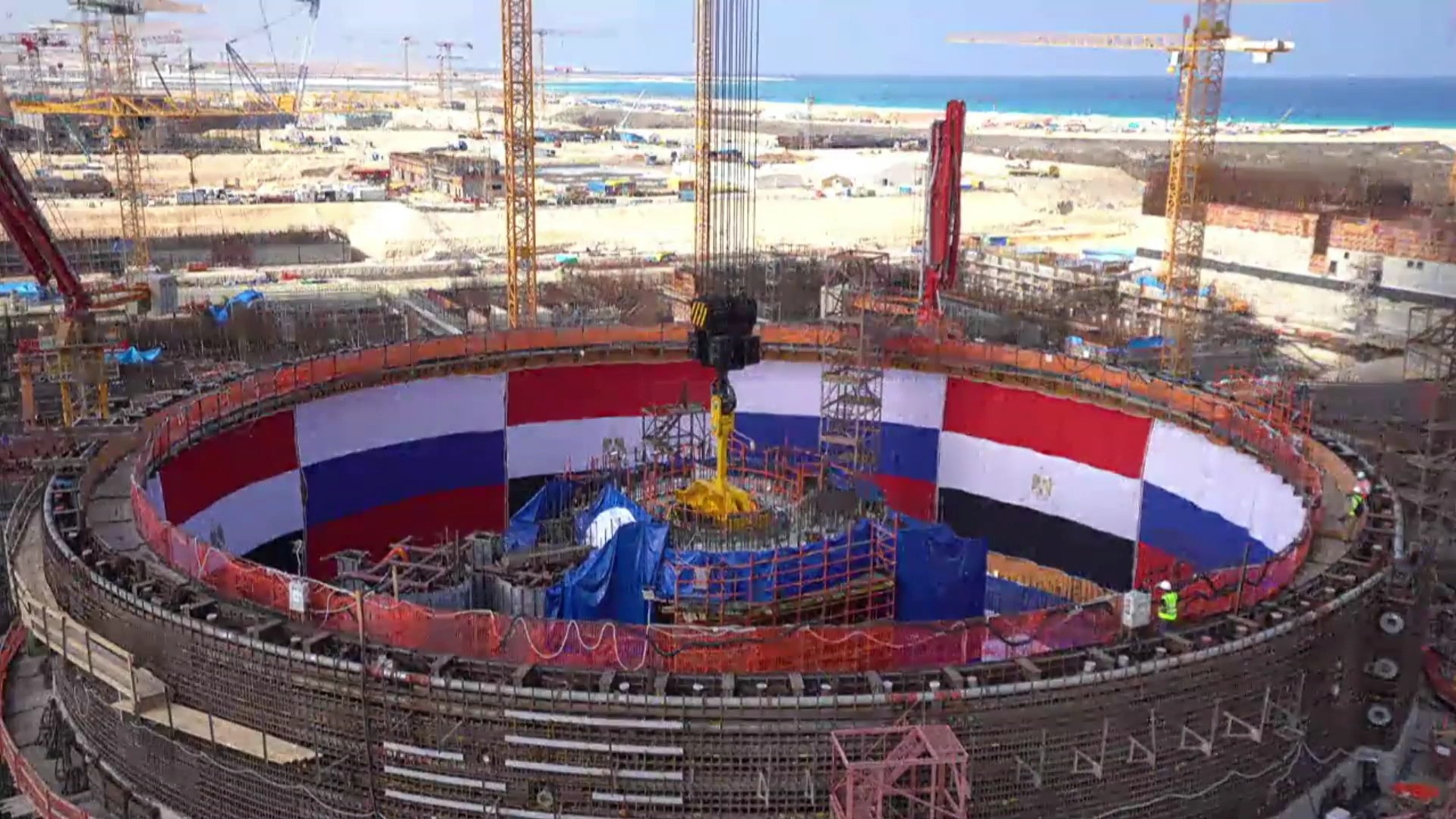
Egypt complained about Rosatom’s nuclear work. Now it wants two more reactors
Just days after Egyptian nuclear authorities reportedly accused Rosatom of construction defects, poor management and vi...
News
Publish date: September 14, 2026
News
Nearly four and a half years after Russia’s full-scale invasion of Ukraine, July offered fresh evidence of how difficult it remains to disentangle Russia from the Western nuclear industry. Germany approved production of fuel for Russian-designed reactors using Russian technology, while new data from Europe and the United States showed that Rosatom retains a substantial share of Western uranium conversion and enrichment markets.
Meanwhile, at the Russian-occupied Zaporizhzhia Nuclear Power Plant, the killing of the station’s Russian-appointed chief engineer underscored a different consequence of the war: the continuing danger faced by those working at Europe’s largest nuclear power station—
On July 15, Rosatom chief Alexey Likhachev said a drone strike on a service vehicle between the Zaporizhzhia plant and the neighboring city of Enerhodar had killed the station’s Russian-appointed chief engineer, Alexander Yakovlev, and his driver. Russia blamed Ukraine, while Kyiv denied responsibility and said there was no independent confirmation of Moscow’s account.
The incident quickly became the subject of competing claims. A Telegram channel subsequently alleged that Yakovlev had opposed allowing Russian personnel access to Westinghouse nuclear fuel stored at the plant and suggested that a dispute over that access might have contributed to his death. The claim has not been independently established.
Bellona nuclear expert Alexander Nikitin cautions against drawing conclusions from such speculation.
“Both sides (Russia and Ukraine) predictably accused each other of the killing,” Nikitin writes. “Who killed one of the several hundred people who die every day in Ukraine, and what the specific reason for this killing was, will never be established. The reason could have been anything, including domestic, financial or other motives, so there is no point in guessing or trying to investigate it. The war will write everything off.”
For Nikitin, Yakovlev’s death instead illustrates the larger danger created by the continued militarization of the plant and surrounding area. “Not only facilities are being destroyed, but people are also being killed, including personnel working at ZNPP and their families living in Enerhodar,” he writes.
Germany, meanwhile, has approved a controversial plan that will preserve another form of Russian involvement in Europe’s nuclear industry.
On July 22, authorities in Lower Saxony approved an application by Advanced Nuclear Fuels, a subsidiary of France’s Framatome, to expand its Lingen plant to manufacture hexagonal fuel assemblies for Russian-designed VVER reactors.
The fuel will be manufactured under Russian licenses and using Russian technology through cooperation with Rosatom’s fuel subsidiary TVEL. The decision came despite objections from some 11,000 people and concerns about espionage, sabotage, cyberattacks and Russian access to critical German infrastructure. Authorities imposed safeguards, including restrictions on access by Rosatom and TVEL personnel and security inspections of Russian equipment.
Bellona nuclear expert Dmitry Gorchakov calls the decision “rather strange” and warns that it undermines efforts to reduce European dependence on Russia.
“Unfortunately, this shows the absence of a single clear policy and principles regarding contacts with official Russian structures, both within Germany itself and within the EU,” Gorchakov writes.
More importantly, he argues, allowing Framatome to meet its VVER fuel commitments with Rosatom’s involvement “may slow the development of its own French VVER fuel independent of Rosatom and prolong Rosatom’s dependence and influence on this market in Europe.”
“Bellona does not approve of this decision by the German authorities or of this cooperation between Framatome and Rosatom,” Gorchakov concludes.
New figures published in July show why severing those ties remains difficult.
The Euratom Supply Agency reported that European suppliers significantly expanded uranium enrichment services in 2025, increasing their share of the EU market from 63.9% to 72.9%. The volume of Russian enrichment services also increased by 11.6% in physical terms. However, their share of the total volume of European orders declined by 22.55% compared with 23.55% a year earlier and 37% in 2023. Russia supplied nearly 16% of the EU’s natural uranium and 24.4% of its conversion services.
The situation is likewise complicated in the United States. According to the U.S. Energy Information Administration, Russia remained the largest single source of enrichment services purchased by American nuclear operators in 2025, providing 3.284 million SWU — about 26% of the total. That was more than the share supplied by U.S. enrichment capacity itself.
“The published statistics in the EU and the US show the continuing dependence of Western nuclear power plant operators and nuclear fuel cycle enterprises on Russian supplies of uranium and its conversion and enrichment services,” Gorchakov says.
“Despite the existence of major European competitors to Rosatom and technical alternatives, up to 20–25% of nuclear materials and nuclear fuel cycle services in European and US markets still originate in Russia.”
For Gorchakov, market forces alone are unlikely to break that dependence. “Only official restrictions and sanctions can break this trend,” he writes, arguing that firm limits would both force reductions in Russian purchases and give Western suppliers confidence that investments in new capacity will pay off.
Taken together, the developments underline a contradiction that has persisted since the beginning of the war. Russia’s occupation of Zaporizhzhia has created unprecedented nuclear safety risks in Ukraine, yet Rosatom remains deeply embedded in nuclear supply chains in the countries supporting Kyiv. Europe and the United States are developing alternatives, but July’s figures — and Germany’s decision in Lingen — suggest that breaking those ties will require political decisions as much as new technology and production capacity.
Just days after Egyptian nuclear authorities reportedly accused Rosatom of construction defects, poor management and vi...
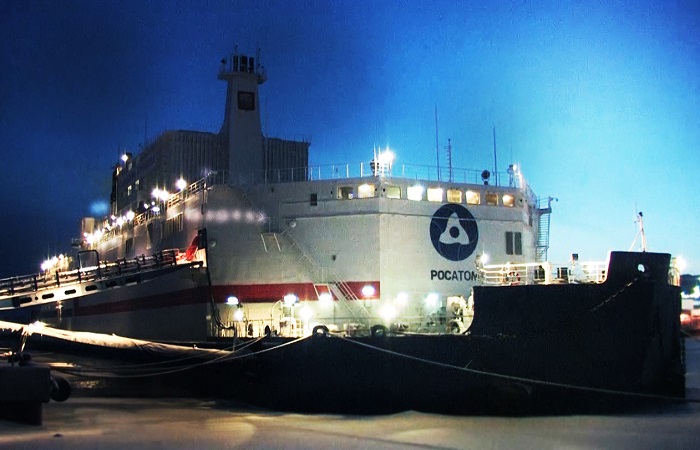
For years, the Akademik Lomonosov looked like one of the nuclear industry’s more eccentric experiments: two reactors mounted on a barge and tow...
Russia’s war against Ukraine continues to reshape the global nuclear industry in ways that extend beyond the battlefield. Western governments a...
Despite sweeping Western sanctions, Russia’s ambitions in the Arctic continue to advance—albeit in increasingly different ways. Novatek’s...