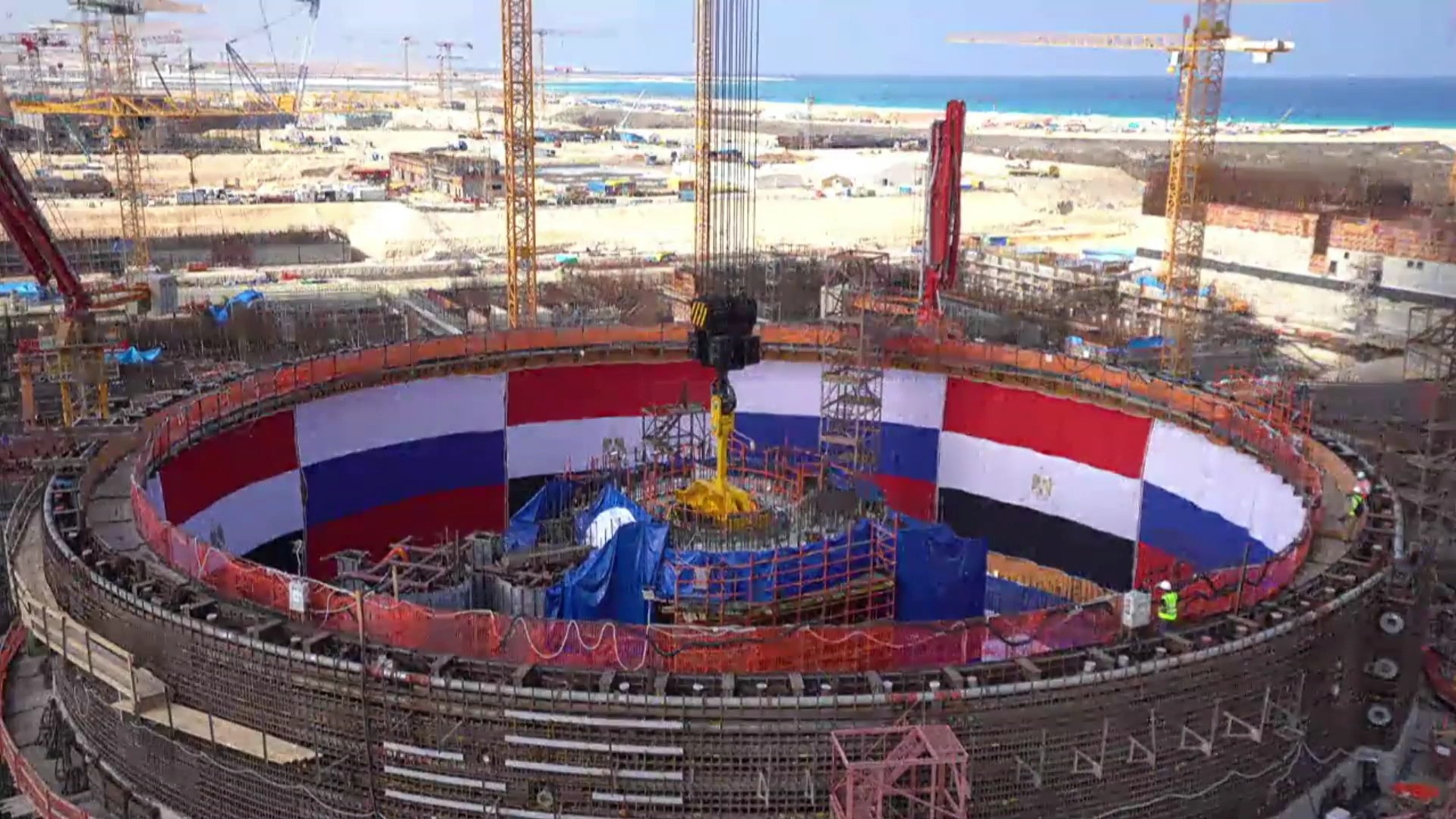
Egypt complained about Rosatom’s nuclear work. Now it wants two more reactors
Just days after Egyptian nuclear authorities reportedly accused Rosatom of construction defects, poor management and vi...
News
Publish date: July 7, 2026
News
Even as the war grinds on, Ukraine continues to expand its civilian nuclear ambitions. Britain has tightened sanctions on Russia’s nuclear sector, while Western dependence on Rosatom remains stubbornly difficult to unwind. Meanwhile, Russia is deepening its strategic nuclear partnership with China as sanctions steadily narrow its options elsewhere. These are among the trends highlighted in Bellona’s May 2026 Nuclear Digest.
Despite the ongoing war and the continued occupation of the Zaporizhzhia Nuclear Power Plant, Ukraine is pressing ahead with an ambitious program to strengthen its nuclear sector.
In May, Energoatom launched domestic production of Westinghouse fuel components, another step toward ending its dependence on Russian nuclear fuel. Ukraine also secured an operating license for its centralized spent nuclear fuel storage facility, allowing it to permanently end shipments of spent fuel to Russia for storage. At the same time, discussions continue over construction of additional nuclear generating capacity.
Yet these advances come amid persistent military threats and renewed concerns over governance.
Throughout May, the International Atomic Energy Agency reported increased military activity around Ukrainian nuclear facilities, particularly the occupied Zaporizhzhia plant. Drone strikes, damage to infrastructure, repeated losses of external power, and competing narratives from Moscow and Kyiv continued to underscore the vulnerability of Europe’s largest nuclear station.
Meanwhile, Ukraine’s anti-corruption authorities launched new investigations involving Energoatom officials, prompting corporate reforms and another reshuffling of the company’s supervisory board.
Bellona nuclear expert Alexander Nikitin argues that both realities must be considered together.
“Despite the ongoing war and the situation surrounding the Zaporizhzhia Nuclear Power Plant and Ukraine’s other nuclear facilities, Energoatom—with the support of the country’s leadership—continues implementing projects aimed at supporting and developing nuclear energy,” he writes. Such efforts, he says, deserve international backing. But at the same time, “support should be accompanied by a careful assessment of their strategic necessity, economic justification, timeliness, and transparency in the use of allocated funds.”
Britain took another step toward reducing its reliance on Russia’s nuclear industry in May, introducing sanctions that prohibit imports of Russian uranium as well as related financial and technical services. The move expands London’s effort to eliminate Russian nuclear fuel from Britain’s energy system by 2028. Yet the practical impact is likely to be modest.
“Britain’s dependence on Russian uranium supplies is relatively small,” Bellona nuclear analyst Dmitry Gorchakov writes. Only one British reactor—Sizewell B—currently uses fuel incorporating Russian nuclear material, and Britain already possesses ample enrichment capacity through Urenco to replace those imports.
The sanctions nevertheless represent another symbolic tightening of Western pressure on Rosatom. At almost the same moment, however, Washington illustrated just how complicated disentangling from Russia’s nuclear supply chain remains.
Earlier in May, the U.S. Nuclear Regulatory Commission approved licenses allowing American companies to export natural uranium to Russia for enrichment before the material is returned for use in U.S. nuclear reactors. The approvals fall under exemptions included in last year’s U.S. ban on Russian enriched uranium imports, which allows waivers when alternative supplies are unavailable or national interests require them.
Taken together, the British sanctions and the U.S. licenses illustrate the contradictory position facing Western governments. Political pressure continues to increase, but decades of integration with Russia’s nuclear fuel cycle continue to make for a difficult divorce.
If sanctions are gradually shrinking Rosatom’s opportunities in Europe and North America, they appear to be pushing the Russian nuclear giant closer toward China.
During President Vladimir Putin’s May state visit to Beijing, Rosatom signed three new memoranda covering workforce development, fusion research, and broader scientific cooperation. The two governments also pledged to deepen cooperation on fast reactors, closed fuel cycles, and future nuclear construction projects.
For our experts, perhaps the most notable element was language calling for joint work on future nuclear power plant construction.
“The provision concerning joint work on nuclear power plant construction deserves particular attention,” Gorchakov writes. “We have repeatedly noted, including in our recently published report on Rosatom in 2025, that Rosatom’s relationship with China’s nuclear industry is strengthening.”
The reasons are clear.
“Given Rosatom’s increasingly difficult position on international markets due to Western sanctions, financial restrictions and the refusal of a number of Western suppliers to provide equipment, Rosatom is being forced to cooperate more closely with China,” Gorchakov concludes.
That cooperation is already extending beyond research. Chinese firms are supplying major components for Russia’s planned floating nuclear power plants, while discussions continue over using Chinese equipment in projects both inside Russia and abroad.
Taken together, the developments illustrate a nuclear industry increasingly shaped less by engineering than by geopolitics. Ukraine is trying to build an independent nuclear future while fighting a war. Western governments continue searching for ways to reduce their dependence on Rosatom without disrupting their own fuel supplies. And Russia, finding many traditional markets more difficult to navigate, is steadily deepening a strategic partnership with China that could reshape the global nuclear landscape for years to come.
Just days after Egyptian nuclear authorities reportedly accused Rosatom of construction defects, poor management and vi...
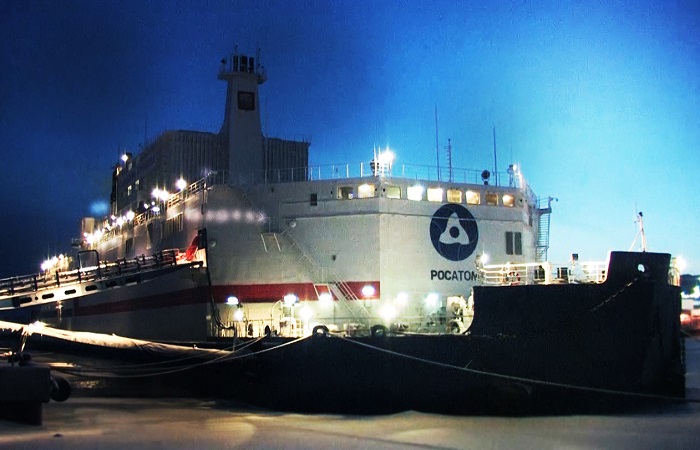
For years, the Akademik Lomonosov looked like one of the nuclear industry’s more eccentric experiments: two reactors mounted on a barge and tow...
Russia’s war against Ukraine continues to reshape the global nuclear industry in ways that extend beyond the battlefield. Western governments a...

Despite sweeping Western sanctions, Russia’s ambitions in the Arctic continue to advance—albeit in increasingly different ways. Novatek’s...