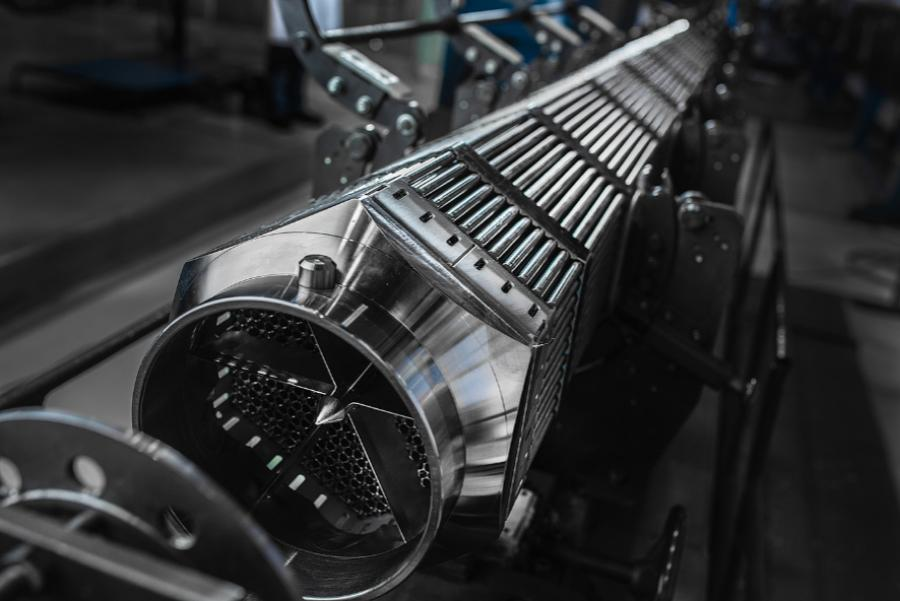
Germany wants independence from Russian nuclear fuel, using Rosatom as a bridge
Europe’s effort to break its dependence on Russian nuclear fuel has a paradox in Germany: making Russian-designed fuel without buying it from Russia ...
News

Publish date: November 4, 2014
News
The potential for saving electricity from used car batteries is growing steadily. The International Energy Agency (IEA) estimates that there will be 4 million electric cars on the roads by 2015, rising to 20 million in 2020.
The popular electric car Nissan LEAF has a battery with a capacity of 24 kWh, while the Tesla Model S has a capacity of 85 kWh. An average electric car sold in Norway could therefore be said to have an estimated capacity of 40 kWh, with a loss of 20% over the 10 years of use before replacement.
If the used battery packs of the stock of 4 million electric cars from 2010 to 2015 are given a new life in the energy sector, the result would be a storage capacity of 128 GWh. This is enough to store and release almost all of Germany’s daily capacity from solar power in peak periods in the summer, or about 10% of all Norwegian wind power annually.
– Even with just a fraction of this capacity we will be able to streamline renewable energy significantly, by cutting price peaks and removing much of the need for back-up power, says Hallstein Havåg.
With the 20 million EVs that are expected to be sold globally by 2020, the storage capacity will exceed 640 GWh. Bellona therefore sees it is very likely that the EV revolution will be followed by a revolution in power supply.
Havåg emphasizes that this is not some utopian vision of the future: – Car manufacturers are already working on reuse of EV batteries, as in Japan where Nissan batteries are being used to provide back-up power supply to hospitals, says Havåg.
Bellona believes this is a trend that Norwegian and European authorities and industry must prepare for, and calls for political commitment also for this aspect of increased EV use.
Find the brief here.
For more information contact:
Maya Vedeld, Communication Advisor
Cell: +47 45871870 E-mail: maya@bellona.no
Europe’s effort to break its dependence on Russian nuclear fuel has a paradox in Germany: making Russian-designed fuel without buying it from Russia ...
Nearly four and a half years after Russia’s full-scale invasion of Ukraine, July offered fresh evidence of how difficult it remains to disentangle Ru...

Just days after Egyptian nuclear authorities reportedly accused Rosatom of construction defects, poor management and vi...
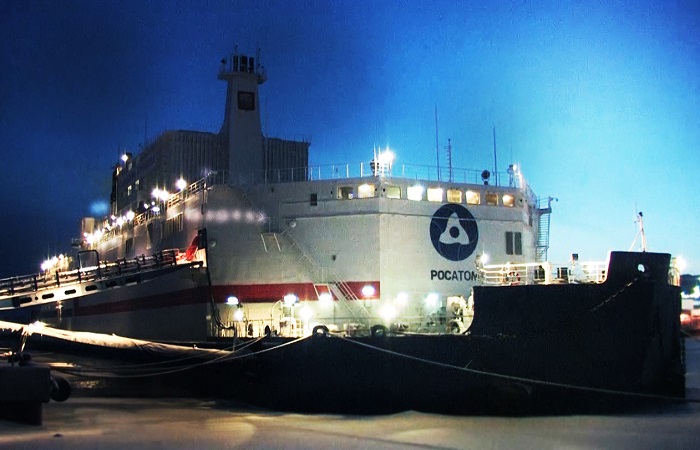
For years, the Akademik Lomonosov looked like one of the nuclear industry’s more eccentric experiments: two reactors mounted on a barge and tow...