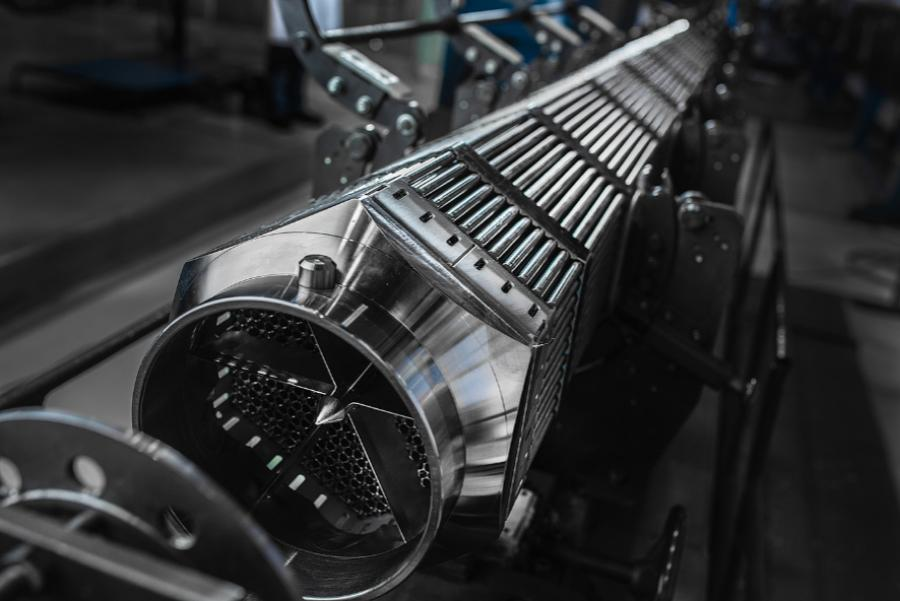
Germany wants independence from Russian nuclear fuel, using Rosatom as a bridge
Europe’s effort to break its dependence on Russian nuclear fuel has a paradox in Germany: making Russian-designed fuel without buying it from Russia ...
News

Publish date: July 2, 2015
News
“In light of the tight timeline to COP 21, it is encouraging to see the world’s heaviest polluter being constructive and committing to undertaking significant CO2 abatement action. Nevertheless, we find it regrettable that no mention was made of last year’s US-China agreement to enhance cooperation in the field of carbon capture, usage and storage (CCUS) and to undertake a major project with enhanced water recovery in China. Such a project would not only act to address China’s climate and water problems, but would also serve as a significant catalyst for deploying CCS globally” argues Jonas Helseth, Director at Bellona Europa, in reaction to China’s climate pledges.
What the Chinese pledge promises
Premier Li Keqiang, who represented China at the summit, announced that the country will cut its CO2 emissions per unit of gross domestic product by 60-65% from 2005 levels. Moreover, China would increase its share of non-fossil fuels as part of its primary energy consumption to about 20% by 2030. 2030 is also the year by which China will aim to peak its emissions of CO2 emissions.
China plans to increase its installed capacity of wind power to 200 GW and solar power to around 100 GW, up from 95.81 GW and 28 GW today, respectively. It will also increase its use of natural gas which is expected to make up more than 10% of its primary energy consumption by 2020.
The Chinese pledge states that the country will aim “to strengthen research and development (R&D) and commercialisation demonstration for low-carbon technologies, such as energy conservation, renewable energy, advanced nuclear power technologies and carbon capture, utilization and storage (CCUS) and to promote the technologies of utilising carbon dioxide to enhance oil recovery and coal-bed methane recovery”.
While pleased at the explicit mention of CCS in the pledge, it is disappointing to see a concrete plan for a CCS project in China being omitted. Given that coal still accounts for around 66% of China’s energy consumption, CCS is an indispensable tool for enabling the country to cut its emissions and sustain economic growth.
Need for concrete action in practice
Despite the country’s announced climate pledges, many remain skeptical of the rate at which Chinese fossil fuels will be phased out. The skepticism is indeed justified, as on the very same day of the EU-China summit, China commenced the construction of a massive pipeline to supply gas from Russia. Moreover, attainment of the pledged peaking of emissions by (or before) 2030 would be particularly challenging given the amount of newly constructed coal-fired power plants in China over the past 15 years, and the long way to go before their retirement.
Europe’s effort to break its dependence on Russian nuclear fuel has a paradox in Germany: making Russian-designed fuel without buying it from Russia ...

Nearly four and a half years after Russia’s full-scale invasion of Ukraine, July offered fresh evidence of how difficult it remains to disentangle Ru...

Just days after Egyptian nuclear authorities reportedly accused Rosatom of construction defects, poor management and vi...

For years, the Akademik Lomonosov looked like one of the nuclear industry’s more eccentric experiments: two reactors mounted on a barge and tow...