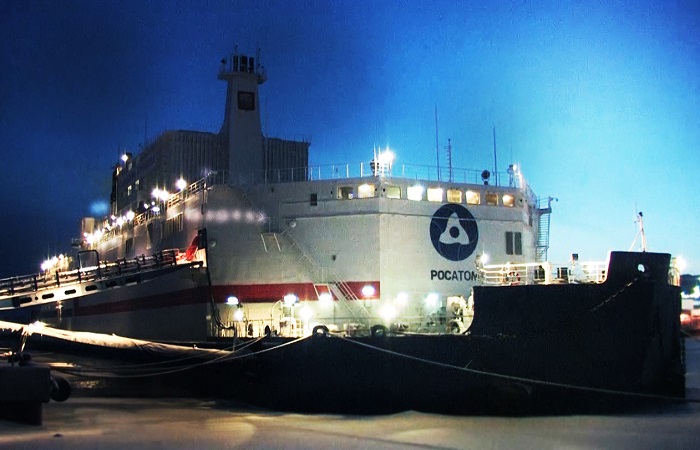
Floating nuclear power was a Russian curiosity. Now others want to give it a shot
For years, the Akademik Lomonosov looked like one of the nuclear industry’s more eccentric experiments: two reactors mounted on a barge and tow...
News

Publish date: September 12, 2000
News
This happens only weeks after the environmental importance of the information in the Bellona report was confirmed by the Kursk tragedy. The submarine, its crew and its two 3rd generation nuclear reactors are now resting on the seabed, while the world is worried about the environmental impacts of the tragedy.
In the light of the Kursk accident this is a suitable time for a reminder: Aleksandr Nikitin was charged with high treason for collecting and transferring to a foreign organisation alleged “secret” information about accidents on Soviet nuclear powered submarines. He was also charged with disclosure of information about the safety systems for nuclear naval reactors of the 3rd generation.
Bellona has all the time claimed that this information is of environmental importance and thus can not be a subject to secrecy under the prevailing Russian legislation, while the prosecution has claimed that the information is of no environmental relevance.
On December 29, 1999, St. Petersburg City Court acquitted Nikitin of all charges, a ruling that was upheld by the Supreme Court’s Collegium on Criminal cases on April 17 this year. The disputed information in the Bellona report must not be secret and, according to the prevailing Russian Legislation, it is not.
The Prosecutor General’s appeal is an attempt to revise this state of the law. Thus, the appeal is not only an attack on the independence of the Russian courts, but also a call for increased secrecy concerning the dangers emanating, in this case, by Russian nuclear powered submarines.
The decision of the Supreme Court Presidium will not only determine the future of Aleksandr Nikitin. It will also give a strong indication of whether Russia will join the community of countries ruled by law, or return to its totalitarian past when the Courts were an extended arm of the state security agencies and where there were no openness concerning the matters of the state.
Aleksandr Nikitin was fully acquitted in December 1999. The acquittal verdict was upheld by the Russian Supreme Court in April 2000. In May 2000, the Prosecutor Generals Office appealed the acquittal to the Presidium of the Supreme Court. But the hearing scheduled for August 2 was postponed until September 13 on the request of one of the judges who said he was on vacation and did not have time to study the case thoroughly.
For years, the Akademik Lomonosov looked like one of the nuclear industry’s more eccentric experiments: two reactors mounted on a barge and tow...

Russia’s war against Ukraine continues to reshape the global nuclear industry in ways that extend beyond the battlefield. Western governments a...

Despite sweeping Western sanctions, Russia’s ambitions in the Arctic continue to advance—albeit in increasingly different ways. Novatek’s...

Even as the war grinds on, Ukraine continues to expand its civilian nuclear ambitions. Britain has tightened sanctions on Russia’s nuclear sect...