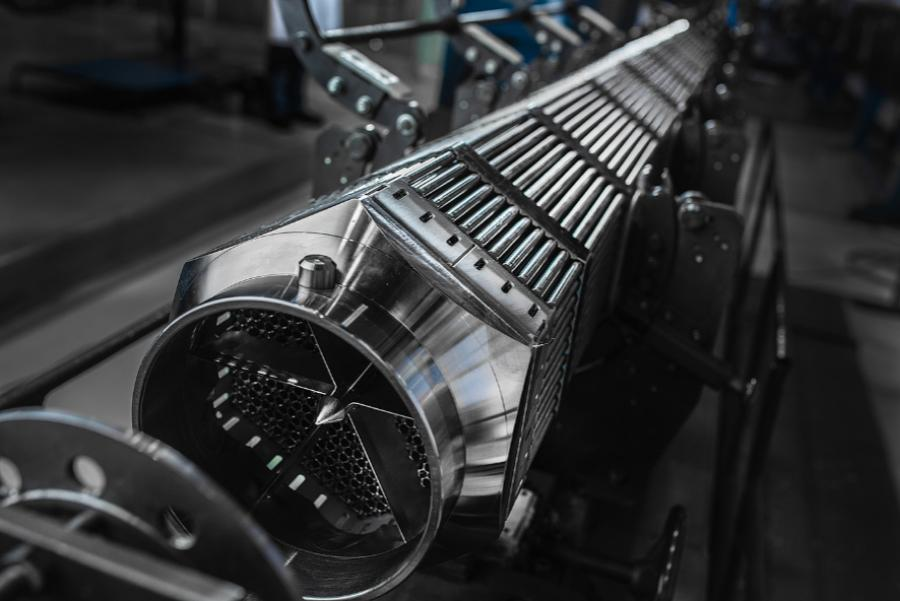
Germany wants independence from Russian nuclear fuel, using Rosatom as a bridge
Europe’s effort to break its dependence on Russian nuclear fuel has a paradox in Germany: making Russian-designed fuel without buying it from Russia ...
News

Publish date: April 25, 2003
Written by: Vladislav Nikifоrov
News
The newly upgraded Russian Typhoon class submarine has left the dry dock of the Sevmash plant in Severodvinsk in June last year. At the moment all the preparatory works before nuclear fuel loading, or so-called operation No.1, are soon to be completed.
Malina class service vessel, PM-63, will load the fuel into the submarine reactors. PM-63 has room to accommodate two sets of fresh nuclear fuel (around 480 fuel assemblies). Sevmash plant has already received approval for the operation from the Main Authority on Nuclear and Radiation Safety of the Russian Defence Ministry. It is scheduled to start loading nuclear fuel already in the middle of June.
The first submarine within Typhoon class — TK-208 — commissioned in 1981 has been under repairs in Severodvinsk since 1989. Its repairs and upgrade seem to near the end as the submarine was taken out of the dry dock and has been undergoing pre-sea trial testing since October 2002. During this long 12-year resting period submarine’s ID-number TK-208 was replaced with name Dmitry Donskoy. Dmitry Donskoy (1350-1389), the Grand Duke of Moscow, In the Kulikovo battle (the battle took place in 1380 in the upper reaches of the Don River, on the Kulikovo field) Dmitry Donskoy displayed his superior military talents. In honour of the victory gained in this battle, the Grand Duke Dmitry achieved the name Donskoy.
Design Bureau Rubin (St Petersburg) developed third generation Typhoon (Akula) class submarine project 941. Sevmash built six Typhoons. The submarine has multi-hulled design, having two parallel main hulls, also called strong hulls, inside the light hull. Maximum diving depth is 400 m. Speed is 12 knots when surfaced and 27 knots when submerged. Typhoon is capable of spending 120 days at sea. The submarine is divided into 19 compartments and powered with two 190 megawatts nuclear reactors.
The longish repairs of Dmitry Donskoy were apparently not caused only by the lack of funding. It is still unclear what type of missile system will installed at the upcoming fourth generation ballistic missile submarines — the first of them, Yury Dolgoruky is currently under construction at Sevmash. Some sources say Dmitry Donskoy could be used as a testing platform for the development of the new missile system. Last year Russian admirals started to refer to Dmitry Donskoy as to the submarine of the forth generation. This submarine built in early 1980 belonged at that time to the third generation. No submarines of the forth generation have been constructed in Russia so far.
Europe’s effort to break its dependence on Russian nuclear fuel has a paradox in Germany: making Russian-designed fuel without buying it from Russia ...
Nearly four and a half years after Russia’s full-scale invasion of Ukraine, July offered fresh evidence of how difficult it remains to disentangle Ru...
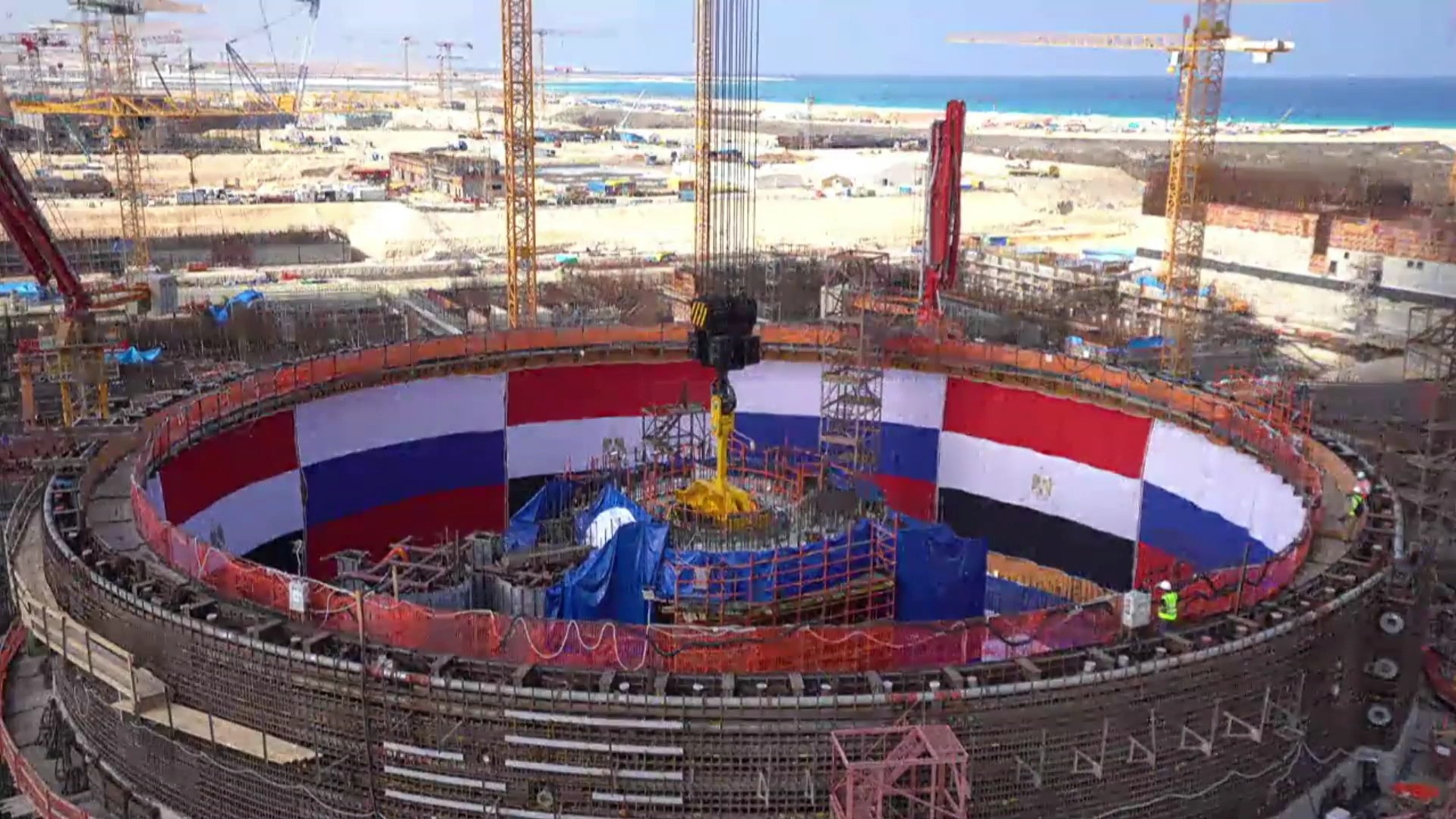
Just days after Egyptian nuclear authorities reportedly accused Rosatom of construction defects, poor management and vi...
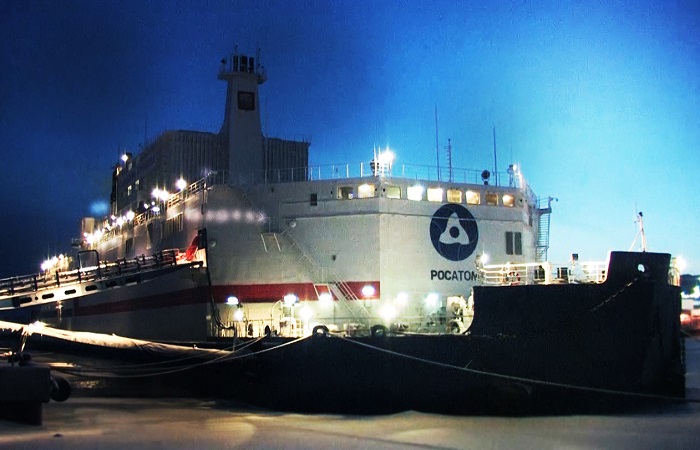
For years, the Akademik Lomonosov looked like one of the nuclear industry’s more eccentric experiments: two reactors mounted on a barge and tow...