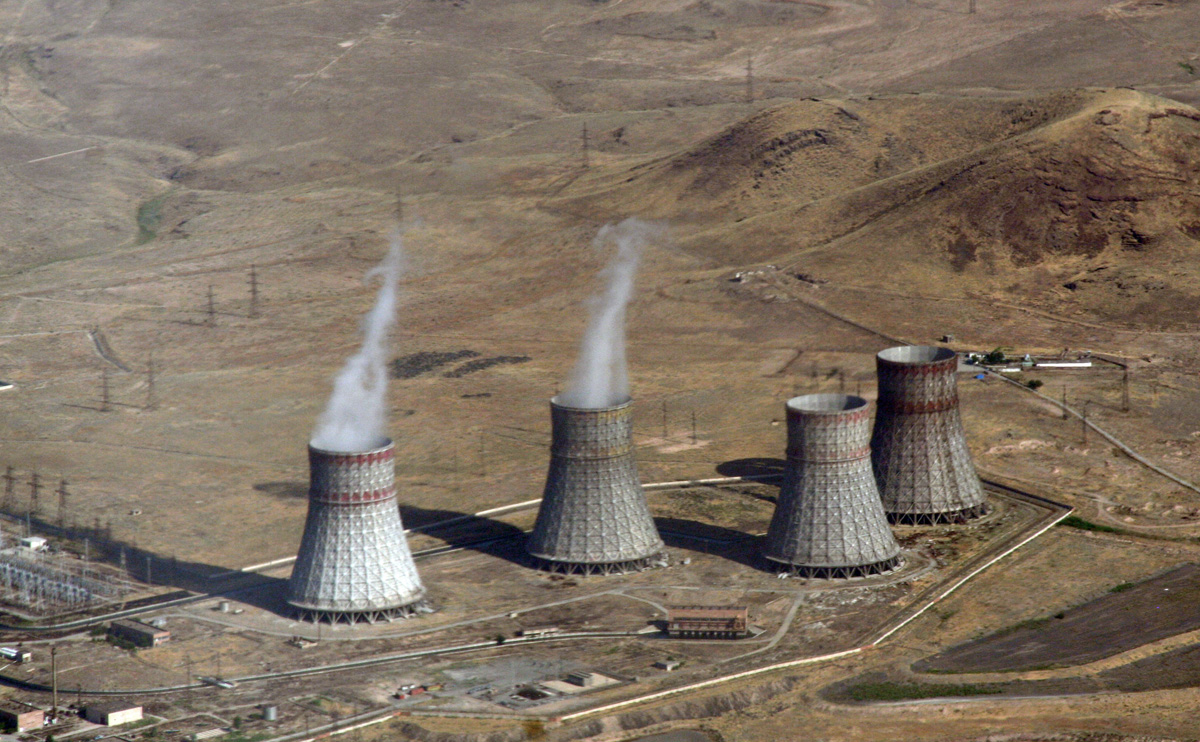
Armenia reconsiders nuclear future as Rosatom offers replacement for aging Soviet reactor
Armenia is reconsidering its plans for a new nuclear power plant after a fresh proposal from Russia’s state nuclear corporation Rosatom and a s...
News
Publish date: November 13, 2008
Written by: Igor Kudrik
News
The report titled "From Polar to Nuclear? ‘Nuclearification’ of the Russian offshore oil and gas industry" was presented at the hearing in the European Parliament hosted by Rebecca Harms, Member of European Parliament (MEP) Greens/EFA, Sirpa Pietikainen, MEP, EPP-ED, and Henrik Lax, ALDE.
Russian research centres are working on designs to apply nuclear energy in developing oil and gas fields in the Russian Arctic. The drafts obtained by Bellona and presented in the new report written by energy security expert Vladislav Larin suggest usage of nuclear energy both to drill and transport oil and gas from the shelf fields located in the Barents and the Kara Seas. The report can be downloaded from the context box on the right.
Prehistory
Russia built more than 250 nuclear powered vessels back in the Soviet era, hundreds of industry plants, and design and research centres were involved in constructing the vessels. After the collapse of the Soviet Union, some two hundred vessels were pulled out of service. Russia and the Russian army were in desperate need of cash. In those turbulent times, the idea of converting nuclear powered submarines into cargo vessels to ship goods under the Arctic ice was hatched.
In August 1995 the Russian Northern Fleet removed torpedoes from one of its attack Victor-III class submarines and sent it on an entirely peaceful mission to deliver potatoes and other cargo to a port on Yamal Peninsula in the Arctic. The trip was a showcase that submarines could be used as underwater transports. The experiment proved, however, not to be economically viable.
Later attempts to reconstruct Typhoons for the purpose of shipping ore from Norilsk nickel plant in the western Siberia ended in vain as well.
The 1980s and 1990s brought the discovery of new oil and gas fields on the shelf of the Barents and Kara Seas. The exploration of these deposits, however, has faced significant limitations due to the severe climate of the Arctic. Because of these factors, the prospect of designing and building an underwater drilling site began to look like a reasonable idea to the oil, gas and nuclear industries. Designers of nuclear-powered submarines believe the technologies they have developed thus far may be applied to offshore oil and gas exploration. They suggest building nuclear-powered underwater drill ships, as well as using nuclear icebreakers and floating nuclear power plants for Russia’s oil and gas venture in the Arctic.
Reactions
MEP Harms looked shocked when she heard about these plans.
"I intend to send an inquiry to the European Commission and bring this question to the agenda with the European Parliament Delegation to Russia," Harms said at the hearing.
European oil and gas development companies such as French Total and Norwegian StatoilHydro will participate in the development of Shtokman gas field in the Russian Arctic—the field specified for nuclearification by the Russian designers.
"Should these plans become a reality, StatoilHydro should withdraw from Shtokman. If they refuse then the (Norwegian) government should ensure they do so," Frederic Hauge, president of the Bellona Foundation, said.
"Bellona fears any oil and gas exploration in the Arctic, because this vulnerable and unknown area of the planet cannot withstand such an industrial load. Bellona’s concern is magnified even more by the notion of utilising nuclear technology for oil and gas exploration and deems this application of nuclear energy particularly irresponsible and reproachable," Nina Lesikhina, the energy projects coordinator for Bellona-Murmansk, who also took part in the hearings, told Bellona Web.
Bellona also concludes in its report that the project is not economically viable. But this can be overturned by large Russian state energy monopolies such as Gazprom, the Russian gas monopoly, and Rosatom, the state corporation which runs nuclear industry in Russia. These companies can exert substantial lobbying pressure to attract the necessary state funding.
Armenia is reconsidering its plans for a new nuclear power plant after a fresh proposal from Russia’s state nuclear corporation Rosatom and a s...

Russia’s state nuclear corporation Rosatom has taken full control of one of the country’s largest logistics companies, consolidating an expanding tra...
August brought signs of growing pressure on several fronts for Russia’s state nuclear corporation Rosatom, from questions surrounding major construct...
The International Atomic Energy Agency has suspended one of its most senior Russian officials — but for reasons largely unrelated to the questions ab...