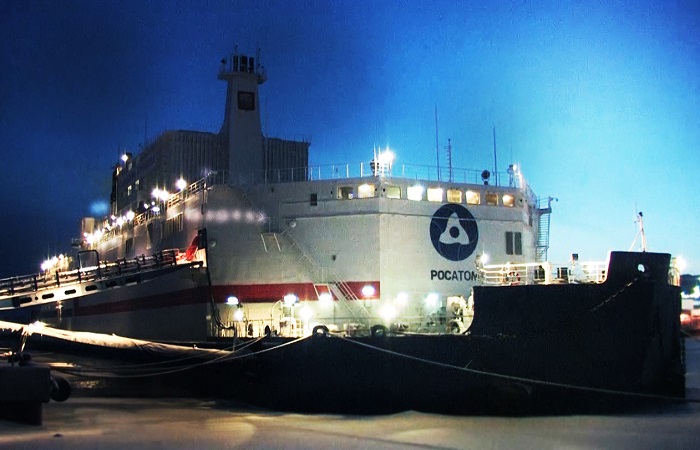
Floating nuclear power was a Russian curiosity. Now others want to give it a shot
For years, the Akademik Lomonosov looked like one of the nuclear industry’s more eccentric experiments: two reactors mounted on a barge and tow...
News

Publish date: October 22, 2007
News
The Bellona Foundation is hosting the seminar “Renewable Energy on the Kola Peninsula: Possibilities and Perspectives” at its office in Oslo Tuesday, October 23.
A scientific report contracted by Bellona and written by the Kola Science Centre “Prospects for Development of Non-traditional and Renewable Energy on the Kola Peninsula” will be presented at the seminar. Guest speakers include representatives from the Kola Science Centre, the Murmansk Oblast, Bellona Murmansk and Norsk Vind Energi AS.
Unknown to many people, the Kola Peninsula is a region with a tremendous amount of non-traditional renewable energy resources which can be developed as ecologically clean, safe alternatives to nuclear and fossil fuels. Bellona has been working with nuclear safety issues in Northwest Russia since 1989, and in 2006 the organisation commissioned the Kola Science Centre of the Russian Academy of Sciences to conduct an investigation of clean renewable energy resources on the Kola Peninsula. Scientific study shows that the region has an enormous potential for wind and hydro power.
The Murmansk administration has initiated measures to investigate possibilities for development of the region’s renewable energy. Earlier this year, the governor of the Murmansk Oblast, committed to developing wind resources equal to 20 per cent of the regions energy complex by the year 2020.
In March 2007, the Oblast Committee for Natural Resources and Environmental Protection established a Working Group on Renewable Energy in the Murmansk Oblast. The working group includes representatives from the regional committee on nature resources and environmental protection, as well as from the Kola Science Centre, Bellona Murmansk and other environmental NGOs. This working group is addressing the obstacles connected with development of clean energy and aims to create a regional programme for renewable energy implementation. This year 400,000 rubles is allocated from the regional budget for its realisation, and the same amount will be allocated for next year.
For years, the Akademik Lomonosov looked like one of the nuclear industry’s more eccentric experiments: two reactors mounted on a barge and tow...
Russia’s war against Ukraine continues to reshape the global nuclear industry in ways that extend beyond the battlefield. Western governments a...

Despite sweeping Western sanctions, Russia’s ambitions in the Arctic continue to advance—albeit in increasingly different ways. Novatek’s...
Even as the war grinds on, Ukraine continues to expand its civilian nuclear ambitions. Britain has tightened sanctions on Russia’s nuclear sect...